How Many Calories in a Protein Shake?
 FoodIdentifier.com
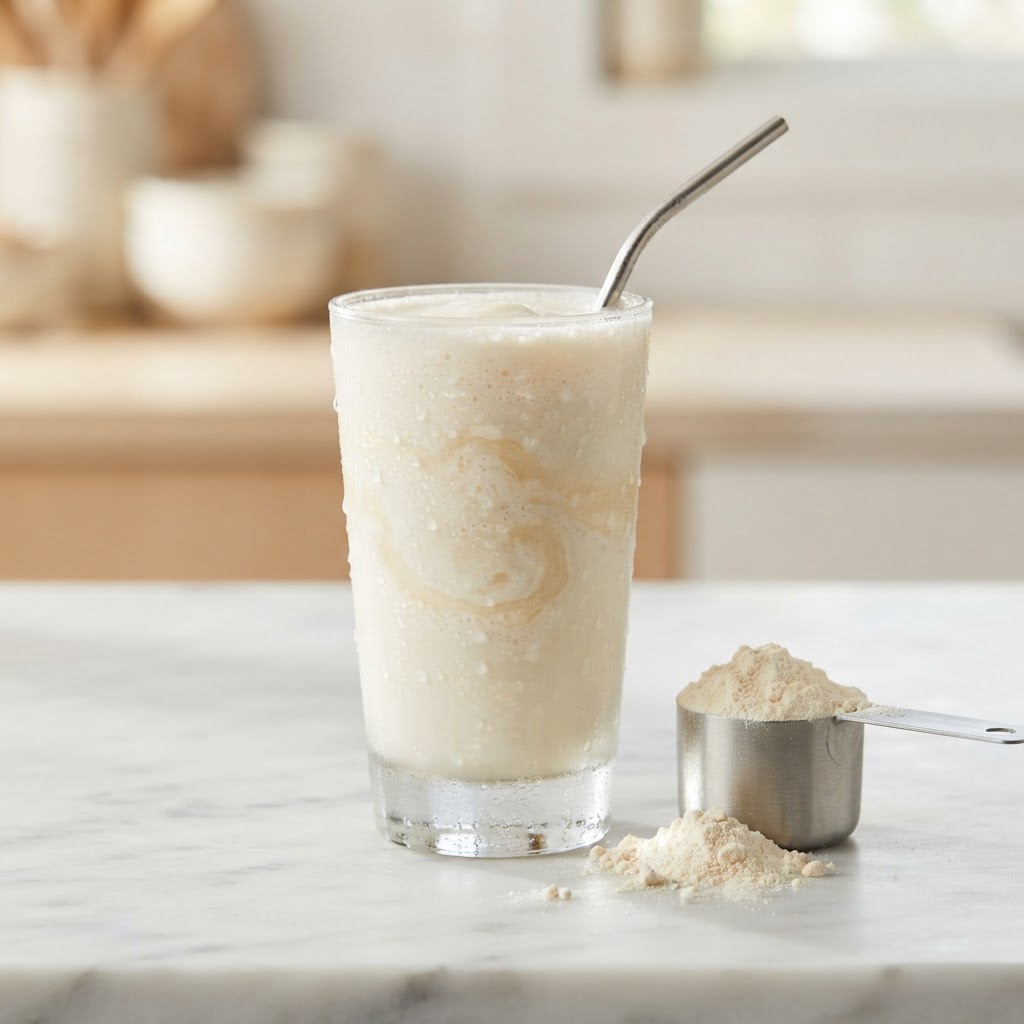
Protein shake calories vary widely by brand and recipe. A standard whey scoop (30g) mixed with water has about 110–130 calories; mixed with milk it has about 200–250 calories; and bottled ready-to-drink shakes range from about 150–350 calories per serving. Check your label — brands vary widely. These are standard USDA-based reference ranges.
🔬 Nutrition Facts — Per 1 Scoop + Water (30g powder)
Source: USDA FoodData Central · 2026
🥗 Key Ingredients & Nutrients at a Glance
📊 Quick Facts
- •1 scoop whey + water (30g): ~120 cal | 24g protein | 3g carbs | 1.5g fat
- •Per 100g (USDA, whey isolate): ~400 kcal | 80g protein | 10g carbs | 5g fat
- •1 scoop + skim milk (250ml): ~200–220 calories
- •1 scoop + whole milk (250ml): ~250–280 calories
- •Bottled ready-to-drink range: ~150–350 calories per serving
- •Premier Protein (330ml): ~160 calories | 30g protein
- •Ensure Original (237ml): ~220 calories | 9g protein
- •+1 tbsp peanut butter: +95 calories
- •+1 medium banana: +105 calories
- •+1 tbsp honey: +64 calories
🚨 Top Problems — Solved
Scan Any Shake or Meal — Get Calories in Seconds
Snap a photo of any food and get instant calories, macros, and nutrition facts. No app download. No sign-up.
📸 Try Free Food ScannerCalories in a Protein Shake — Why Brand and Recipe Change Everything
Protein shake calories vary widely by brand and recipe. A standard whey scoop (30g) mixed with water has about 110–130 calories; mixed with milk it has about 200–250 calories; and bottled ready-to-drink shakes range from about 150–350 calories per serving. Per USDA FoodData Central, whey protein isolate is about 400 kcal per 100g, so a 30g scoop is about 120 calories with about 24g of protein. The biggest variable is what you mix it with (water vs milk) and what you add to it (peanut butter, banana, honey, oats). Check your label — brands vary widely. These are generic USDA-based values.
Why Protein Shakes Are Useful — But Easy to Over-Drink
A scoop of whey with water is one of the most protein-dense foods per calorie — about 24g of protein for 120 calories, or about 80g of protein per 100g. That makes it useful for hitting protein targets in a calorie deficit. But protein shakes are easy to over-drink: a 'healthy' shake with whole milk, banana, and peanut butter can hit 470–600 calories, and bottled shakes can be 220–350 calories with more sugar than you expect. If you drink a shake on top of your regular meals without tracking it, you can easily add 300–500 calories a day and stall weight loss. For weight loss, mix with water, keep add-ins minimal, and build the shake into your daily calorie target.
🥤 Full Nutrition Facts — Plain Whey Isolate (Per 100g and Per Scoop 30g + Water)
Complete nutrition facts for a representative plain whey protein isolate, based on USDA FoodData Central reference values. This is a baseline — flavored powders, blends, and bottled shakes differ and are shown in the tables below.
| Nutrient | Per 100g | Per Scoop (30g + water) | % Daily Value (per scoop) |
|---|---|---|---|
| Calories | ~400 kcal | ~120 kcal | 6% |
| Protein | ~80 g | ~24 g | 48% |
| Total Carbohydrate | ~10 g | ~3.0 g | 1% |
| • Dietary Fiber | ~0.5 g | ~0.2 g | 1% |
| • Total Sugars | ~3 g | ~1.0 g | — |
| Total Fat | ~5 g | ~1.5 g | 2% |
| • Saturated Fat | ~2.5 g | ~0.8 g | 4% |
| Sodium | ~330 mg | ~100 mg | 4% |
| Potassium | ~500 mg | ~150 mg | 3% |
| Calcium | ~400 mg | ~120 mg | 12% |
| Cholesterol | ~50 mg | ~15 mg | 5% |
🥤 Protein Shake Calories by Mix — Powder + Water vs Milk vs Bottled
Per-serving calories for the most common protein shake preparations. Powder + water is lightest (110–130 cal); powder + whole milk is higher (250–280 cal); bottled ready-to-drink shakes range widely (150–350 cal). Check your label — brands vary widely. Values are representative USDA-based estimates.
| Preparation (per serving) | Calories | Protein | Carbs | Fat | Notes |
|---|---|---|---|---|---|
| 1 scoop (30g) + water | ~120 kcal | 24g | 3g | 1.5g | Lightest — water adds 0 cal |
| 1 scoop (30g) + skim milk (250ml) | ~205 kcal | 32g | 13g | 1.5g | Skim milk adds ~85 cal |
| 1 scoop (30g) + whole milk (250ml) | ~270 kcal | 32g | 13g | 9.5g | Whole milk adds ~150 cal |
| 1 scoop (30g) + almond milk (250ml) | ~130 kcal | 25g | 3g | 2g | Unsweetened almond milk adds ~10 cal |
| Bottled Premier Protein (330ml) | ~160 kcal | 30g | 5g | 3g | Low sugar RTD |
| Bottled Ensure Original (237ml) | ~220 kcal | 9g | 32g | 6g | Higher carbs/sugar |
| Bottled Fairlife (350ml) | ~150 kcal | 30g | 8g | 2.5g | Low sugar RTD |
| Bottled Boost High Protein (237ml) | ~240 kcal | 20g | 28g | 6g | Higher carbs |
Why the range? A scoop with water is about 120 calories; the same scoop with whole milk is about 270 — the milk adds 150 calories. Bottled shakes range from 150 (Fairlife) to 240 (Boost) because of different protein sources, sugar, and serving sizes. Check your label — brands vary widely. See also our Protein Calculator to set your daily target.
🥤 Added Ingredients That Raise Protein Shake Calories
A simple 120-calorie shake (powder + water) can become a 400–600-calorie shake with add-ins. Check your label — brands vary widely. Values are representative USDA-based estimates per single serving of each ingredient.
| Added Ingredient | Amount | Calories | Protein | Carbs | Fat |
|---|---|---|---|---|---|
| Peanut butter | 1 tbsp (16g) | ~95 kcal | 4g | 3g | 8g |
| Banana | 1 medium (118g) | ~105 kcal | 1.3g | 27g | 0.4g |
| Honey | 1 tbsp (21g) | ~64 kcal | 0.1g | 17g | 0g |
| Oats (dry) | ½ cup (40g) | ~150 kcal | 5g | 27g | 3g |
| Whole milk | 250ml | ~150 kcal | 8g | 12g | 8g |
| Skim milk | 250ml | ~85 kcal | 8g | 12g | 0.2g |
| Almond butter | 1 tbsp (16g) | ~98 kcal | 3g | 3g | 9g |
| Olive oil / coconut oil | 1 tbsp (14g) | ~120 kcal | 0g | 0g | 14g |
Track Every Shake — Instantly
Snap a photo of any food to get instant calories, macros, and nutrition facts. No app download. No sign-up.
📸 Scan Your Food Free🥤 Protein Shake vs Protein Bar vs Greek Yogurt — Calories, Protein, Sugar Per Serving
Per serving, a protein shake with water (110–130 cal, 24g protein) is typically the lowest-calorie, highest-protein option. A protein bar is more portable but higher in calories (200–280 cal) and sugar. Greek yogurt is a whole-food alternative with similar protein and fewer additives. Check your label — brands vary widely. Values are representative USDA-based estimates.
| Food (per serving) | Calories | Protein | Sugar | Fat |
|---|---|---|---|---|
| 🥤 Protein shake (1 scoop + water) | ~120 kcal | ~24g | ~1g | ~1.5g |
| 🥤 Protein shake (1 scoop + whole milk) | ~270 kcal | ~32g | ~13g | ~9.5g |
| 🍫 Protein bar (standard) | ~200–280 kcal | ~15–20g | ~5–15g | ~6–12g |
| 🥛 Greek yogurt (170g, nonfat) | ~100 kcal | ~17g | ~6g | ~0.5g |
| 🍫 Chocolate milk (250ml) | ~190–210 kcal | ~8g | ~24g | ~5g |
| 🥤 Bottled RTD shake (330ml) | ~150–240 kcal | ~20–30g | ~2–15g | ~2–6g |
Practical Tips for Making and Tracking Protein Shakes
- Mix with water or skim milk, not whole milk: Water adds zero calories; skim milk adds about 85; whole milk adds about 150. Switching from whole milk to water cuts about 150 calories per shake — about 1,050 per week if you drink one daily.
- Measure add-ins, don't pour freely: One tablespoon of peanut butter is about 95 calories; a 'heaping spoonful' can be 2–3 tablespoons (190–285 cal). Use a measuring spoon or food scale for peanut butter, honey, and oats.
- Read the label on bottled shakes: Bottled RTD shakes range from 150–350 calories and 2–15g of sugar. Compare calories, protein, and sugar per serving — not just the front-of-pack 'high protein' claim.
- Build the shake into your daily calorie target: If you add a 270-calorie shake on top of your regular meals, you are in a surplus. Either replace a snack with the shake or log it in your daily total using the Calorie Calculator.
- Use a shake to hit protein, not to replace meals: A scoop with water (120 cal, 24g protein) is a low-calorie way to hit your protein target. Use the Protein Calculator to find your daily target.
Protein Shakes and Weight Loss — Next Steps
A protein shake can be part of a weight-loss diet if it fits your calorie target. A scoop with water (110–130 cal, 24g protein) is a low-calorie, high-protein option that helps preserve muscle in a deficit. Here's how to use shakes for weight loss:
- Mix with water, not whole milk: A scoop with water is about 120 calories; with whole milk it is about 270. That 150-calorie difference, daily, is about 1,500 calories over 10 days — enough to stall or reverse weight loss.
- Keep add-ins to one ingredient: A scoop + water + one banana is about 225 calories. A scoop + whole milk + banana + peanut butter is about 470. If you want flavor, pick one add-in and measure it.
- Replace a snack, don't add to meals: If you eat your regular meals and add a 270-calorie shake, you are in a surplus. Replace a less protein-dense snack with the shake so total calories stay the same.
- Compare to whole-food protein: A 170g cup of nonfat Greek yogurt has about 100 calories and 17g of protein — similar protein, fewer calories, no additives. Shakes are convenient; yogurt is cheaper and whole-food.
For your daily calorie and protein targets, use the Calorie Calculator and Protein Calculator. This is not medical advice — talk to your doctor.
Scan Any Shake or Meal — Get Calories in Seconds
Snap a photo of any food and get instant calories, macros, and nutrition facts. No app download. No sign-up.
Keep tracking your nutrition
Compare protein shakes to other foods, calculate your daily targets, and build a simple daily habit streak to stay consistent.
Ask Lana
The questions everyone asks
Real answers, like a friend would give them — warm, honest, and always with your next tiny step.
Educational only — not medical advice. Talk to your doctor.
Get Your 30-Day AI Weight Loss Meal Plan Bundle
Pre-calculated calorie targets, high-protein meal ideas, protein shake recipes, and grocery lists — all in one PDF bundle.
Get Meal Plan Bundle — $19.99 →Scan Any Food Instantly — Free
No sign-up. No app. Snap a photo → full nutrition in 3 seconds.
Try Free Food Scanner →🔧 Free Health Tools
❓ Frequently Asked Questions (8)
Click any question to expand the expert answer
🔗 Core Tools
📊 Popular Content Hubs
Scan Any Food Instantly — Free
No sign-up. No app. Snap a photo → get full nutrition in 3 seconds.
Try Free Food Scanner →📋 Nutrition data based on USDA FoodData Central. Values may vary by brand, preparation method, and serving size. Not a substitute for professional medical or dietary advice. Always consult a registered dietitian for personalized nutrition guidance.