🏥 Trusted by GLP-1 users in 30+ countries · Built for Ozempic, Wegovy, Mounjaro, Zepbound · Free forever
Home › Tools › Ozempic Food Checker
Ozempic Food Checker — Instantly Know if Any Meal Is GLP-1 Safe and Optimal
Scan any meal and instantly see protein score, nausea risk, muscle protection score, and GLP-1 friendly rating. Prioritize meals scoring Excellent or Good. Up to 40 percent of weight lost on GLP-1 without proper diet can be muscle.
⚡ What This Tool Does
FoodIdentifier's Ozempic Food Checker scans any food and gives you a GLP-1 Nutrition Panel showing: Protein Score, Nausea Risk, Nutrient Density, Muscle Protection Score, and an overall GLP-1 Friendly Rating. Designed for the 23% of US households now using GLP-1 medications. Free, no sign-up, no download required.
💉 GLP-1 Food Checker
Enter any food to see its Ozempic/GLP-1 compatibility score
📋 Get Your Free 7-Day GLP-1 Meal Plan
Built specifically for Ozempic and Wegovy users — high protein, zero nausea, emailed free
Why Nutrition Becomes 10x More Critical When You Start Ozempic or Wegovy
GLP-1 receptor agonists work by mimicking a naturally occurring gut hormone that signals fullness to the brain, slows gastric emptying, and reduces appetite. The average GLP-1 user consumes 30% fewer total calories — which sounds positive until you realize this means every single bite must now deliver three times the nutritional value to meet the body's minimum requirements for protein, vitamins, and minerals.
Without deliberate dietary management, GLP-1 users commonly develop five critical nutritional deficiencies: protein (leading to muscle loss and metabolic slowdown), vitamin B12 (affecting energy and nerve function), iron (causing fatigue and cognitive impairment), calcium (bone density loss), and vitamin D (immune function and hormone balance). These deficiencies are not inevitable — they are the result of eating the wrong foods at reduced volume.
The Ozempic Food Checker solves this by analyzing every meal for its GLP-1 suitability before you eat, ensuring that even at reduced calorie intake you are maximizing protein, minimizing nausea risk, and protecting muscle mass. This tool is built specifically for the unique nutritional demands of GLP-1 medication users.
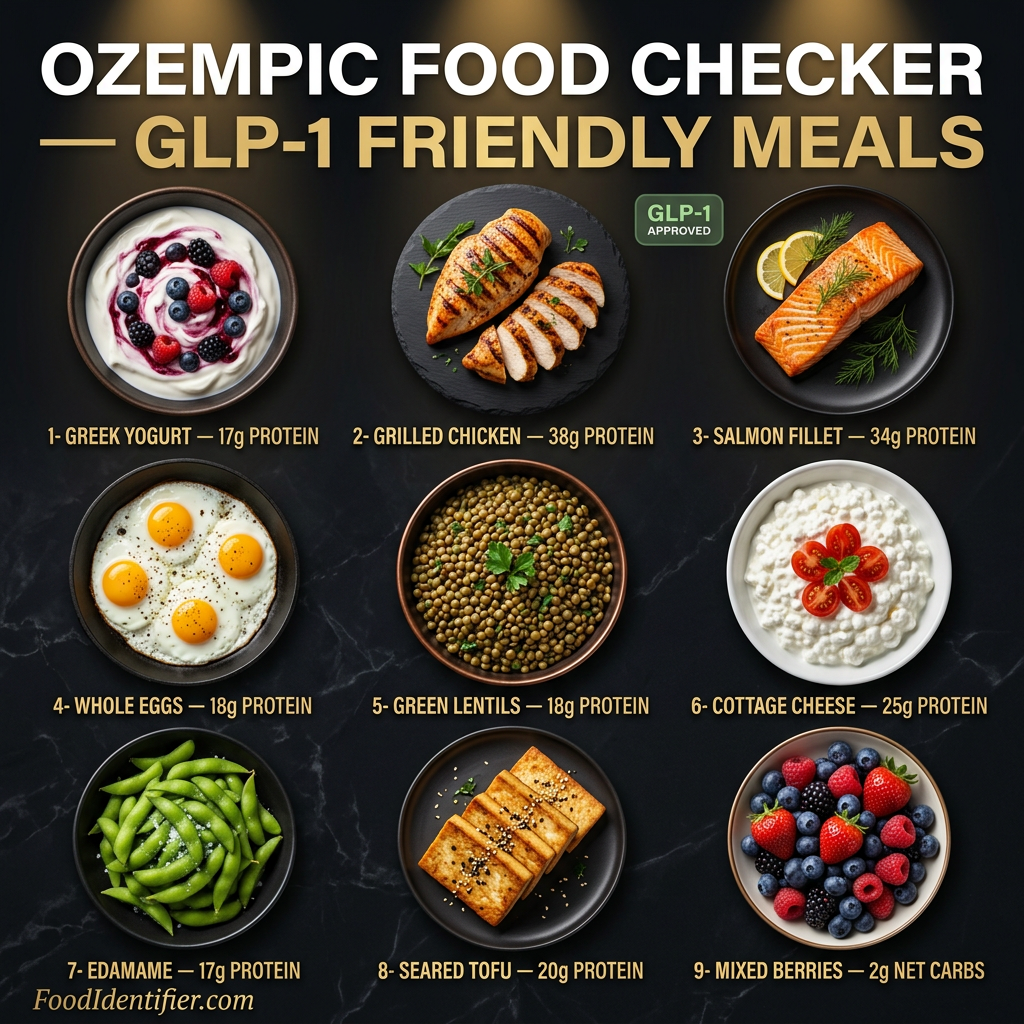
Top 30 Foods for GLP-1 Users — Ranked
Muscle Protection on Ozempic — The Science
The New England Journal of Medicine published research in 2024 demonstrating that without deliberate dietary management, up to 25-40% of weight lost on GLP-1 medications can be muscle mass rather than fat. This is known as muscle wasting or sarcopenia-adjacent lean mass loss, and it has serious long-term consequences including reduced metabolic rate, increased fall risk, and decreased functional capacity.
The leucine threshold is the most critical concept GLP-1 users need to understand. Research shows that 2.5 to 3 grams of leucine per meal is the minimum required to trigger muscle protein synthesis. High-leucine foods include whey protein (11% leucine by weight), chicken breast, beef, fish, eggs, and soy protein. Building every meal around a high-leucine protein source is the single most impactful nutritional strategy for preventing muscle loss on GLP-1 medications.
How FoodIdentifier Compares
Free vs Pro — GLP-1 Features
✅ Free Forever
⭐ Pro — $9/month
Frequently Asked Questions
❓ What foods should I avoid on Ozempic to prevent nausea?
The foods most likely to cause or worsen nausea on Ozempic are high-fat foods including fried foods, greasy fast food, creamy sauces, full-fat red meat, and high-fat dairy. GLP-1 medications slow gastric emptying, and fatty foods stay in the stomach longer, compounding this effect and causing severe nausea. Carbonated beverages, alcohol, spicy foods, and large portions of any food also commonly trigger nausea. The solution is smaller portions, low-fat cooking methods, and eating slowly over at least 20 minutes per meal.
❓ How much protein do I need per day on Ozempic?
The minimum safe protein intake on GLP-1 medications is 1.2 grams per kilogram of body weight per day to prevent muscle loss. For optimal muscle preservation during weight loss, aim for 1.5-2.0 grams per kilogram. For a 180-pound person this equals approximately 100-160 grams of protein per day. Because GLP-1 medications significantly reduce appetite and total food intake, hitting protein targets becomes challenging and requires deliberate planning at every meal.
❓ What is the GLP-1 Friendly Rating on the food checker?
The GLP-1 Friendly Rating evaluates a food across five metrics: protein content per serving, nausea risk based on fat content and food type, nutrient density per 100 calories, muscle protection score based on leucine content, and overall suitability for someone eating smaller portions on a GLP-1 medication. Foods rated Excellent are high in protein, low nausea risk, nutrient-dense, and optimal for muscle preservation. Foods rated Avoid are typically high-fat, low-protein, or calorie-dense without proportional nutrition.
❓ Can I eat fruit on Ozempic?
Yes, most fruits are appropriate on GLP-1 medications. Low-sugar fruits including berries, apples, oranges, and kiwi are excellent choices due to their fiber, vitamins, and antioxidant content. Avoid large portions of very high-sugar fruits like mangoes, grapes, and bananas in large quantities. The key consideration on Ozempic is portion size since appetite suppression means every calorie must deliver maximum nutrition. Fresh whole fruits consistently outperform fruit juices or dried fruits for nutrition-to-calorie ratio.
❓ Does Ozempic cause muscle loss?
Research published in the New England Journal of Medicine in 2024 showed that up to 25-40% of weight lost on GLP-1 medications without deliberate dietary management can be muscle mass rather than fat. This occurs because severe appetite suppression leads to insufficient protein intake, and the body in a caloric deficit can break down muscle for energy. Preventing this requires meeting daily protein targets, performing resistance training at least 3 times per week, and potentially adding creatine supplementation per emerging 2024-2025 research.
❓ What is the leucine threshold and why does it matter on GLP-1?
Leucine is a branched-chain amino acid that acts as a direct trigger for muscle protein synthesis. Research shows you need at least 2.5 to 3 grams of leucine per meal to meaningfully activate muscle building and preservation pathways. On GLP-1 medications where total food intake is dramatically reduced, many people fall below this threshold because they are eating smaller portions with insufficient protein. Foods with the highest leucine content per gram of protein include whey protein, chicken breast, beef, fish, eggs, and soy protein.
❓ How does the Ozempic Food Checker work?
The Ozempic Food Checker analyzes any food description or photo and evaluates it across five GLP-1 specific criteria: protein content and quality, fat content and nausea risk profile, nutrient density per calorie, leucine content and muscle protection score, and overall GLP-1 compatibility. The checker is built specifically for people on Ozempic, Wegovy, Mounjaro, and Zepbound and accounts for the unique nutritional demands created by GLP-1 medications. Results appear in under 5 seconds with specific improvement suggestions.
❓ What are the best breakfast foods on Ozempic?
The best breakfasts on Ozempic prioritize high protein content, low nausea risk, and high nutrient density in small volumes. Top choices include Greek yogurt with berries, 2-3 scrambled eggs with spinach, cottage cheese with fruit, a small protein smoothie with protein powder and berries, or smoked salmon on a small slice of whole grain bread. Avoid large breakfasts and foods that are very high in fat or very high in refined carbohydrates as both categories commonly trigger nausea in GLP-1 users.
❓ Is this Ozempic food checker free?
Yes, the Ozempic Food Checker is completely free with no sign-up required. The free version provides the basic GLP-1 rating, protein score, and nausea risk for 3 food checks per day. The Pro plan at $9 per month adds the full 5-metric GLP-1 panel, personalized protein target calculations based on your exact body weight and dosage, 7-day GLP-1 optimized meal plan, muscle protection protocol, weekly nutrition report, and unlimited food checks.
❓ Can I use the food checker for Mounjaro and Wegovy?
Yes. The GLP-1 Friendly Rating system works for all GLP-1 and GLP-1/GIP dual agonist medications including semaglutide brands Ozempic and Wegovy, tirzepatide brands Mounjaro and Zepbound, liraglutide brand Victoza and Saxenda, and dulaglutide brand Trulicity. While different medications have slightly different side effect profiles and potencies, the core nutritional principles are identical: maximize protein, minimize nausea triggers, optimize nutrient density, and protect muscle mass.
❓ How do I hit my protein target on Ozempic when I have no appetite?
Hitting protein targets with severely suppressed appetite requires strategic prioritization of protein at the very start of every meal before other foods, choosing the highest-protein foods available, and potentially using protein supplements like Greek yogurt, cottage cheese, or protein shakes to bridge gaps. Eating protein-rich foods when you have the most appetite, typically during the hours when medication effect is lowest, also helps. Liquid protein sources like Greek yogurt smoothies can deliver 25-30g of protein in a small volume when solid food is unappealing.
❓ What foods boost natural GLP-1 production?
Several foods have been shown in research to stimulate the body's natural GLP-1 hormone secretion. High-protein foods trigger significant GLP-1 release from intestinal L-cells, as do fermented foods, high-fiber foods particularly prebiotic fibers from oats, leeks, onions, and garlic, and foods rich in long-chain fatty acids like avocado and olive oil. April 2026 Stanford research identified specific polyphenol compounds in olive oil and certain vegetables that may amplify GLP-1 receptor sensitivity, though this research is still emerging.