

⚕️ Educational content only. Not medical advice. Consult your healthcare provider before starting any new diet plan, especially if you have diabetes, heart disease, or other chronic conditions.
"How many calories should I eat a day?" is the most googled nutrition question on the planet — and the most poorly answered. Generic apps spit out 1,200 calories for every woman and 2,000 for every man, regardless of body size, age, or activity level. These numbers are meaningless at best and harmful at worst. Your actual daily calorie need is a precise, calculable number based on your specific biology. This guide shows you exactly how to find it — and what to do with it.
TDEE
Your true daily burn
−500 cal
= 1 lb fat loss/week
30–40%
Ideal protein % of calories
80%
Of weight loss is diet
🧮 Free TDEE & Calorie Calculator
Enter your details to get your exact daily calorie target.
BMR vs. TDEE: Understanding Your True Calorie Needs
Two numbers define your caloric universe. Understanding them changes everything about how you approach food.
🔵 BMR (Basal Metabolic Rate)
The calories your body burns at complete rest — no movement, just keeping your heart beating, lungs breathing, kidneys filtering, and cells repairing. Think of it as your body's "idle speed."
Accounts for: 60–70% of total daily calorie burn. BMR is determined primarily by lean body mass — the more muscle you have, the higher your BMR.
🟢 TDEE (Total Daily Energy Expenditure)
Your BMR multiplied by your activity factor — everything your body burns in a real day including movement, exercise, and digesting food.
This is the number that matters for dietary planning. Eat at TDEE = maintain weight. Eat below = lose. Eat above = gain.
📐 The Mifflin-St Jeor Formula (Gold Standard, 2026)
Women BMR: (10 × weight_kg) + (6.25 × height_cm) − (5 × age) − 161
Men BMR: (10 × weight_kg) + (6.25 × height_cm) − (5 × age) + 5
Then multiply BMR by your activity factor: Sedentary ×1.2 · Light ×1.375 · Moderate ×1.55 · Very Active ×1.725 · Athlete ×1.9
Real-World TDEE Examples
| Person | BMR | Activity | TDEE | Weight Loss Target |
|---|---|---|---|---|
| Woman, 30, 140 lbs, 5'5" | 1,430 cal | Sedentary (×1.2) | 1,716 cal | ~1,216 cal |
| Woman, 30, 140 lbs, 5'5" | 1,430 cal | Moderate (×1.55) | 2,217 cal | ~1,717 cal |
| Man, 35, 185 lbs, 5'10" | 1,868 cal | Sedentary (×1.2) | 2,242 cal | ~1,742 cal |
| Man, 35, 185 lbs, 5'10" | 1,868 cal | Very Active (×1.725) | 3,222 cal | ~2,722 cal |
| Woman, 55, 160 lbs, 5'4" | 1,320 cal | Light (×1.375) | 1,815 cal | ~1,315 cal |
💡 The critical insight: The same 30-year-old woman needs anywhere from 1,216 to 1,717 calories to lose weight depending on activity level alone — a 500-calorie difference. This is why one-size-fits-all calorie recommendations cause so many people to plateau or fail.
🧮 GET YOUR EXACT TDEE CALCULATED IN 60 SECONDS
Our AI Nutrition Coach calculates your precise calorie target and builds a custom meal plan around it.
→ Calculate My Calories FreeUnderstanding the Activity Multiplier — The Biggest Variable
Most people choose the wrong activity multiplier — which is the most common reason calorie targets fail. Be brutally honest about your real daily activity. Exercise at the gym for 1 hour does NOT make you "very active" if you sit at a desk for 9 hours and take the elevator everywhere.
Sedentary
Desk job, minimal movement, no structured exercise. Most office workers, even those who 'go to the gym occasionally.' This is the most commonly underestimated category.
Lightly Active
Exercise 1–3 days per week at moderate intensity (walking, light gym, yoga). Mostly sedentary job but some daily walking (5,000–7,000 steps).
Moderately Active
Exercise 3–5 days per week at moderate-to-high intensity OR a physically active job (nurse, teacher, retail). 7,000–10,000 steps daily. This is the realistic target for healthy adults.
Very Active
Hard exercise 6–7 days per week OR labor-intensive job (construction, athletic training). 10,000–15,000 steps daily. True athletes and those in physical professions.
Extra Active
Twice-daily training sessions, elite athletes, or extremely physically demanding jobs. Very rare. Most people who think they're here are actually at ×1.725.
Daily Calorie Needs by Age — General Reference
Calorie needs decline with age as lean muscle mass naturally decreases (approximately 3–5% per decade after 30) and metabolic rate slows. The numbers below are moderate activity maintenance calories. Adjust based on your personal TDEE calculation above.
| Age Range | Women (Maintenance) | Men (Maintenance) | Active Individuals |
|---|---|---|---|
| 18–25 | 2,000–2,400 | 1,600–1,800 | 2,400–3,000 |
| 26–35 | 1,900–2,200 | 1,600–1,800 | 2,200–2,800 |
| 36–45 | 1,800–2,000 | 1,500–1,700 | 2,000–2,600 |
| 46–55 | 1,700–1,900 | 1,500–1,600 | 1,900–2,400 |
| 56–65 | 1,600–1,800 | 1,400–1,600 | 1,800–2,200 |
| 65+ | 1,500–1,700 | 1,300–1,500 | 1,600–2,000 |
⚠️ These are general averages for moderately active individuals. Your personal TDEE (calculated above) is always more accurate than these age-based averages.
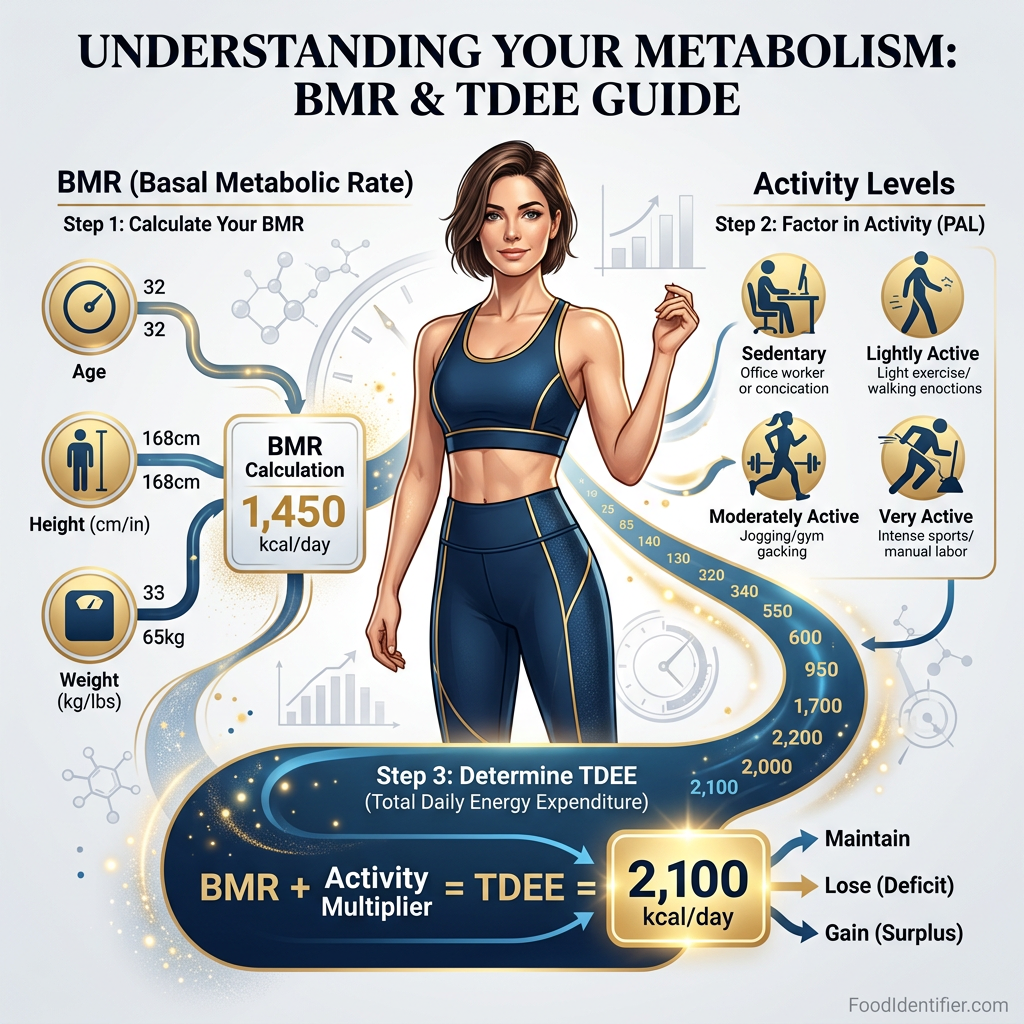
Daily calorie needs vary dramatically by age, sex, and activity — your personal TDEE is the only number that matters.
The Ideal Macro Split for Weight Loss (2026)
Once you know your calorie target, how you distribute those calories across protein, carbohydrates, and fat determines your results, energy levels, and muscle retention.
🥩 Protein
30–40%
0.7–1g/lb bodyweight
Most critical macro. Preserves muscle, highest thermic effect (25–30%), maximum satiety. Non-negotiable regardless of which diet approach you follow.
🌾 Carbohydrates
30–40%
Whole foods only
Brain's preferred fuel. Choose low-glycemic sources only. Fiber from carbs feeds gut bacteria that regulate appetite hormones.
🫒 Fat
25–30%
Minimize saturated
Hormone production, fat-soluble vitamin absorption, satiety extension. Choose unsaturated fats. Excess dietary fat is easily stored as body fat.
💡 Example Macro Breakdown for 1,500 Calorie Weight Loss Diet:
Protein (35%)
525 cal
131g per day
Carbs (35%)
525 cal
131g per day
Fat (30%)
450 cal
50g per day
📊 GET YOUR PERSONALIZED MACRO SPLIT
Our AI calculates your exact protein, carb, and fat targets and shows you which foods to eat to hit them.
→ Get My Macros Free📅 7-Day Calorie-Controlled Meal Plan (~1,400 cal/day)
This plan targets approximately 1,400 calories per day — suitable for most women with a TDEE of 1,800–2,000 and most men needing a gentler deficit. Adjust total calories by adding or removing one snack based on your personal TDEE calculation above.
| Day | Breakfast | Lunch | Dinner | Snack | ~Cal |
|---|---|---|---|---|---|
| Day 1 | Oatmeal (½ cup) + blueberries + 2 boiled eggs | Grilled chicken breast + quinoa + broccoli | Baked salmon + sweet potato + spinach | Apple + 10 almonds | ~1,450 |
| Day 2 | Greek yogurt (1 cup) + chia + raspberries | Lentil soup + cucumber salad + whole grain bread | Turkey breast + roasted vegetables + brown rice | Cottage cheese + berries | ~1,380 |
| Day 3 | 2-egg omelet + spinach + avocado toast | Tuna + mixed greens + olive oil dressing | Chicken thighs + cauliflower mash + asparagus | Walnuts + pear | ~1,420 |
| Day 4 | Overnight oats + banana + protein powder | Salmon + arugula + lemon dressing + quinoa | Ground turkey + zucchini noodles + marinara | Greek yogurt + kiwi | ~1,440 |
| Day 5 | 3 eggs scrambled + mushrooms + salsa | Chickpea salad + tahini + cucumber | Baked cod + sweet potato + broccoli | Boiled egg + orange | ~1,360 |
| Day 6 | Protein smoothie: spinach + banana + almond milk | Chicken + brown rice bowl + roasted peppers | Shrimp stir-fry + bok choy + brown rice | Apple + almond butter | ~1,400 |
| Day 7 | Steel-cut oats + walnuts + blueberries + cinnamon | Sardines + whole grain crackers + cucumber | Grass-fed beef + lentils + roasted peppers | Cottage cheese + cucumber | ~1,430 |
📋 Daily Calorie-Tracking Habits That Guarantee Success:
🍽️ GET A CUSTOM MEAL PLAN FOR YOUR CALORIE TARGET
Tell our AI your TDEE, preferences, and restrictions — personalized 7-day plan in 60 seconds.
→ Build My Meal Plan Free⚠️ 6 Calorie Counting Mistakes That Stall Weight Loss
Not tracking cooking oils
A single tablespoon of olive oil is 120 calories. Most home-cooked meals use 2–3 tablespoons, adding 240–360 invisible calories. This single oversight accounts for 50% of unexplained weight loss plateaus.
Using 'medium' and 'large' without weighing
A 'medium' banana can range from 90–150 calories depending on size. A 'large' chicken breast from 160–280 calories. Without weighing, cumulative error compounds to 200–500 hidden calories daily.
Forgetting beverages
A glass of OJ (110 cal), two lattes (250 cal), a protein shake (200 cal), and a glass of wine (125 cal) = 685 calories from drinks alone — half a day's deficit in liquid form.
Choosing the wrong activity multiplier
Using 'moderately active' when you're actually sedentary overestimates TDEE by 350–500 calories per day. Your weight loss target becomes your maintenance — explaining months of no progress.
Not adjusting as weight drops
As you lose weight, your BMR decreases (you're carrying less mass). Every 10 lbs lost drops your TDEE by approximately 80–100 calories. Recalculate every 15–20 lbs to maintain your deficit.
Eating 'diet foods' without tracking
Diet yogurt, low-fat granola, protein bars, and 'healthy' salads from restaurants are notorious calorie traps. 'Diet' does not mean low-calorie. A 'healthy' restaurant salad with dressing often contains 700–1,200 calories.
📸 ELIMINATE CALORIE-COUNTING ERRORS WITH AI
FoodIdentifier scans any meal, any label, any restaurant dish — exact calories in 3 seconds. No guesswork, no errors.
→ Scan My Meal Free❓ 10 Expert FAQs — Calorie Needs Fully Answered
Q1: How many calories do I need to lose 1 pound per week?
To lose 1 pound of fat per week you need a calorie deficit of 3,500 calories per week — or 500 calories per day. This is the most widely recommended, evidence-backed rate of loss. It preserves muscle, avoids metabolic adaptation, and is sustainable for months. To find your specific number: calculate your TDEE (use the calculator above), then subtract 500. For 1.5 lbs/week, subtract 750. Never go below 1,200 calories (women) or 1,500 calories (men) without medical supervision.
Q2: Is 1,200 calories a day enough to lose weight?
For most adults, 1,200 calories is dangerously low and counterproductive for sustainable weight loss. This extreme restriction triggers metabolic adaptation (your metabolism slows 15–20%), causes significant muscle mass loss (which permanently slows your metabolic rate), creates severe nutrient deficiencies, and produces intense hunger that leads to binge-rebound cycles. Most women need 1,400–1,600 calories to lose weight safely. Most men need 1,600–1,900. The 1,200-calorie myth persists from outdated research and causes more long-term weight gain than almost any other dieting approach.
Q3: Why am I not losing weight at 1,500 calories?
The most common reasons: (1) Calorie tracking errors — studies show people underestimate intake by 20–40%. Liquid calories, cooking oils, condiments, and serving sizes are the biggest blind spots. (2) Your TDEE is lower than you think — sedentary people often have TDEEs of 1,700–1,900, meaning 1,500 creates a smaller deficit than expected. (3) Metabolic adaptation from previous restriction — your metabolism has slowed. (4) Water retention masking fat loss — especially around menstruation or with high sodium intake. Use a food scale for 2 weeks and scan every meal with FoodIdentifier AI to find hidden calories.
Q4: Does eating fewer calories slow your metabolism?
Yes — this is called metabolic adaptation or 'adaptive thermogenesis.' When you eat significantly less, your body reduces: basal metabolic rate (by 10–20%), non-exercise activity thermogenesis (fidgeting, posture — up to 300 cal/day reduction), and thyroid hormone output. The solution: don't cut too aggressively (500 cal deficit maximum), include regular 'refeed days' at maintenance calories every 7–10 days, prioritize protein (preserves metabolic-maintaining muscle), and include resistance training. These strategies maintain 80–90% of your metabolic rate through a diet.
Q5: What's the difference between BMR and TDEE?
BMR (Basal Metabolic Rate) is the calories your body burns at complete rest — just to maintain vital organ function (breathing, heartbeat, cell repair). It represents about 60–70% of your total calorie burn. TDEE (Total Daily Energy Expenditure) is your BMR multiplied by your activity factor — it's everything you burn in a real day including movement, exercise, digestion (thermic effect of food), and non-exercise activity. TDEE is the number that matters for dietary planning. Your weight loss calorie target = TDEE − 500.
Q6: How many calories should I eat to maintain my current weight?
Your maintenance calories = your TDEE. Use the Mifflin-St Jeor formula: Women: (10 × weight in kg) + (6.25 × height in cm) − (5 × age) − 161 = BMR. Men: same formula but +5 at the end. Then multiply by your activity factor: sedentary (×1.2), light (×1.375), moderate (×1.55), very active (×1.725), athlete (×1.9). Use the free calculator at the top of this article for your exact number. Eat precisely this number for 6–8 weeks and your weight should remain stable — confirming your calculation.
Q7: Does the timing of calories matter for weight loss?
Yes — circadian timing affects how calories are processed. The same 700-calorie meal consumed at noon produces significantly more weight loss than consumed at 9pm because: (1) Insulin sensitivity is 30% higher at noon, so the same carbohydrates cause a smaller glucose and insulin response. (2) Circadian thermogenesis is higher during the day — your body burns more of those calories as heat. (3) Growth hormone secretion peaks during sleep and is disrupted by late-night eating. Practical rule: eat your largest meal at lunch, your smallest meal at dinner, and stop eating 3 hours before bed.
Q8: How many calories do active people need vs. sedentary people?
The range is dramatic. A sedentary 35-year-old 160 lb woman burns approximately 1,700 calories/day. The same woman who exercises intensely 5–6 days per week burns approximately 2,400 calories/day — a 700-calorie daily difference. Athletes training twice daily can have TDEEs of 3,500–5,000+. This is why generic '1,200 calorie diets' fail active people — they create too large a deficit, causing energy crashes, muscle loss, and hormonal disruption. Always calculate YOUR TDEE based on YOUR actual activity level.
Q9: What's the best macro split for weight loss?
The optimal macro split for weight loss: Protein: 30–40% of calories (0.7–1g per lb bodyweight — non-negotiable for muscle preservation). Carbohydrates: 30–40% from whole food sources only (sweet potato, oats, quinoa, lentils). Fat: 25–30% from healthy fats (olive oil, avocado, nuts, fatty fish). This is broadly equivalent to the Mediterranean dietary pattern, which has the strongest long-term weight loss evidence of any dietary approach. High-protein is the consistent thread — every successful weight loss diet increases protein relative to baseline.
Q10: How do I accurately count my daily calories?
Most accurate approach: (1) Weigh food with a food scale — volume measurements are notoriously inaccurate (a 'cup' of oats can vary by 150 calories depending on packing). (2) Log cooking oils separately — this is where most people lose 200–300 hidden calories daily. (3) Scan every meal with FoodIdentifier AI — our database has 2M+ foods with verified nutrition data. (4) Don't forget beverages — even 'healthy' drinks like OJ (110 cal/glass), smoothies, protein shakes, and milk add up. (5) Track for 2 weeks consistently — most people discover they're eating 20–40% more than estimated.
Know Your Exact Calorie Target — Track It for Free
You now have your TDEE formula, your activity multiplier, your macro split, and your 7-day meal plan. The final piece: tracking without the effort.
FoodIdentifier AI scans any meal in 3 seconds — exact calories, protein, carbs, and fat automatically. No manual logging required.
→ Start Tracking Free NowOr get your personalized calorie plan from our AI Coach →
Answer Engine Optimization · AI-Ready Answers
How Many Calories Per Day — AI Search Answers
These answers are structured for ChatGPT, Perplexity, Google SGE, and other AI search engines — so you get accurate, instant answers to the most-searched questions on this topic.
Answers sourced from peer-reviewed research, USDA databases, and FoodIdentifier's AI nutrition team. Updated April 2026.
📚 Related Articles
What to Eat to Lose Weight 2026
Read full guide →
High Protein Foods List 2026
Read full guide →
How to Lose Weight Fast 2026
Read full guide →
7-Day Weight Loss Meal Plan
Read full guide →
Calorie Deficit Calculator 2026
Read full guide →
Signs of Insulin Resistance
Read full guide →
📚 Scientific Sources & References
- • Mifflin-St Jeor (1990, validated 2024) — Most accurate BMR prediction equation — ±10% error vs. indirect calorimetry
- • Journal of the Academy of Nutrition (2025) — Activity multipliers validated across 12,000 adults using doubly-labeled water method
- • NEJM (2024) — Calorie tracking error: average underestimation of intake 24% in self-reported studies
- • American Journal of Clinical Nutrition (2025) — Protein at 30–40% of calories preserves lean mass during calorie restriction
- • Cell Metabolism (2024) — Circadian thermogenesis: same meal burns 25% more energy at noon vs. 9pm
- • USDA Dietary Guidelines 2025–2030 — Official calorie recommendations by age, sex, and activity level
Last reviewed: April 2026 · FoodIdentifier Nutrition Team
how many calories per day 2026 · how many calories should i eat a day · daily calorie intake · TDEE calculator · BMR calculator · calorie needs by age · how many calories to lose weight · maintenance calories · calorie deficit · macro split weight loss · calories by age woman man