 FoodIdentifier
How Many Calories in a Banana? Every Size, Every Stage of Ripeness, Answered Properly
How many calories in a banana? 105 in a medium one — but size and ripeness change the story. Full size table, protein, carbs and honest weight-loss answers.
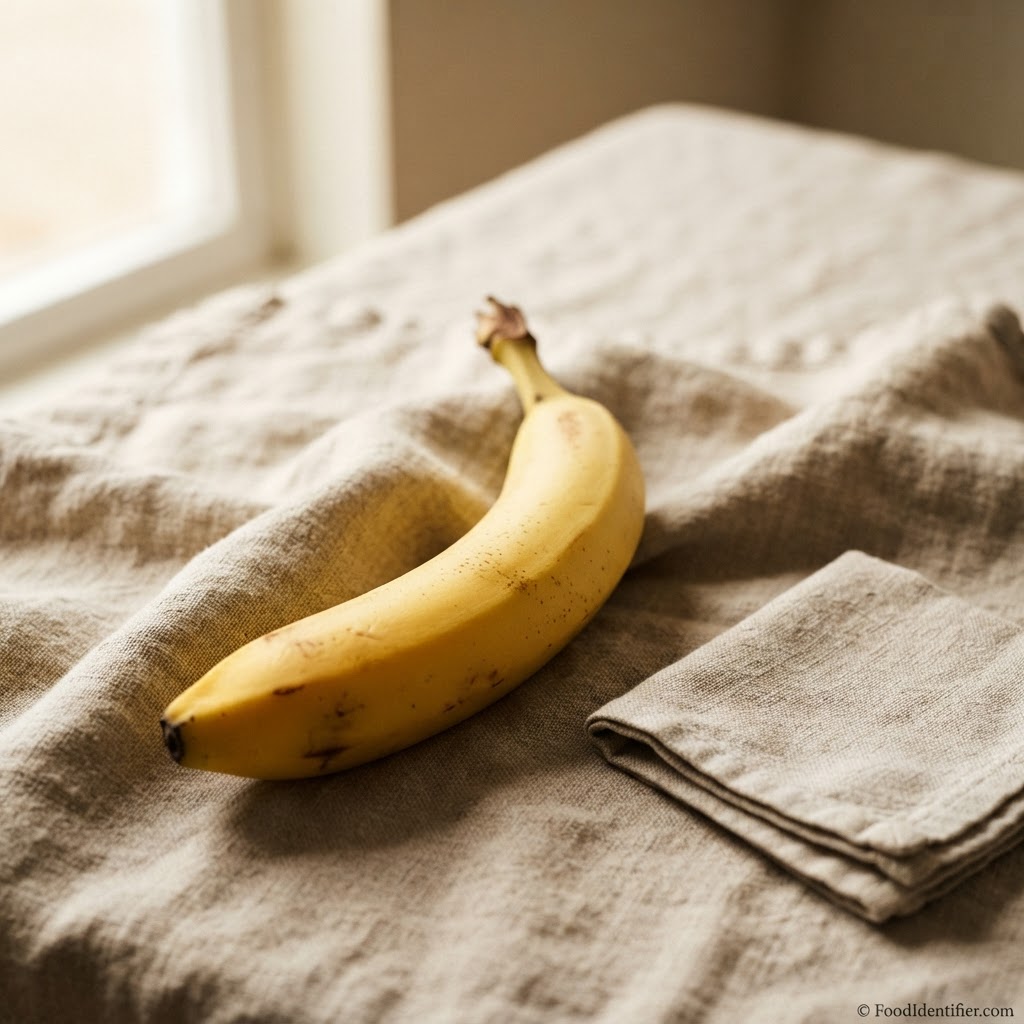
Weigh or photograph any food free at FoodIdentifier.com — calories and macros in seconds, no app, no sign-up.
Key takeaways
- ▶A medium banana has 105 calories. That’s the honest short answer: a medium Cavendish banana (about 118g, 7–8 inches) carries 105 calories, 27g of carbs and 3.1g of fiber.
- ▶Size swings the answer more than anything. An extra-small banana is about 72 calories; an extra-large one runs to about 135. “A banana” is not a unit of measurement.
- ▶Bananas are not a protein food. You get 1.3g of protein in a medium banana — about 1.1g per 100g. Eat it for energy, fiber and potassium, and get your protein somewhere else.
- ▶Ripeness changes the sugar, not the calories. A green banana and a spotty brown one land at roughly the same calorie count; what shifts is starch turning into sugar.
- ▶Weight is the truth. Bananas are sold by length but live by grams. Per 100g, a banana is 89 calories — weigh yours once and you’ll never guess again.
No app download, no sign-up, no card. Point your phone at your next meal and see the calories, protein and carbs in about five seconds.
Scan a food free — no app, no sign-up →Why this guide exists (when the short answer is one number)
If you only need the number, here it is again: 105 calories in a medium banana. Our quick-answer page gives you exactly that, with nothing around it — how many calories in a banana, the one-line answer.
So why write several thousand words about it? Because the questions people actually bring to my scanner almost never stop at the number. They ask about their banana — the big one from the gas station, the green one that won't ripen, the spotty one they're about to throw away, the one their doctor raised an eyebrow at. The number 105 only answers the question for a banana of exactly 118 grams, and in my experience almost nobody is holding a banana of exactly 118 grams.
I've weighed a lot of bananas building FoodIdentifier — they are one of the most-scanned single foods we see, and they are also the food where people's guesses are most confidently wrong. Someone logs "one banana, 105 calories" while holding a 150-gram monster that actually runs 135. That's not a rounding error; that's a third of the snack they think they ate. This guide is everything I've learned sits between the simple question and the honest answer: sizes weighed, ripeness stages explained, comparisons against the fruits bananas actually compete with, and straight talk about weight loss and blood sugar.
First, a definition: what counts as "a banana"?
Almost every number in this guide refers to the Cavendish banana — the standard yellow banana sold in nearly every supermarket in the US and Europe. It's the banana in the USDA reference data, the banana in your fruit bowl, and the banana this question almost always means.
What "a banana" is not, for the purposes of these numbers:
- ▶Not a plantain. Plantains are the banana’s starchy cooking cousin — bigger, firmer, almost always cooked, and more calorie-dense per bite once fried or roasted. Different food, different numbers.
- ▶Not a banana chip. Chips are sliced banana fried in oil — a legitimate snack, but at roughly 520 calories per 100g they belong in the chips conversation, not the fruit conversation. More on this below.
- ▶Not banana bread, banana muffins or banana \u201Cnice cream\u201D with add-ins. Once butter, sugar, flour or chocolate enters, the banana is a supporting actor.
One more definitional point, and it's the one that matters most: banana "sizes" — small, medium, large — are retail length categories, not weights. Two bananas can both measure 7½ inches and differ by 20 grams because one is thicker. Length is what the shop can print on a sign. Weight is what your body actually receives. That's why every table in this guide leads with grams.
The direct answer: calories in a banana by size
Here is the table this whole cluster of questions is really asking for. Weights and calories are the USDA reference values for raw Cavendish bananas at each standard size.
| Size | Typical length | Weight (edible) | Calories |
|---|---|---|---|
| Extra small | Under 6 inches | 81g | 72 |
| Small | 6 to 6⅞ inches | 101g | 90 |
| Medium | 7 to 7⅞ inches | 118g | 105 |
| Large | 8 to 8⅞ inches | 136g | 121 |
| Extra large | 9 inches or longer | 152g | 135 |
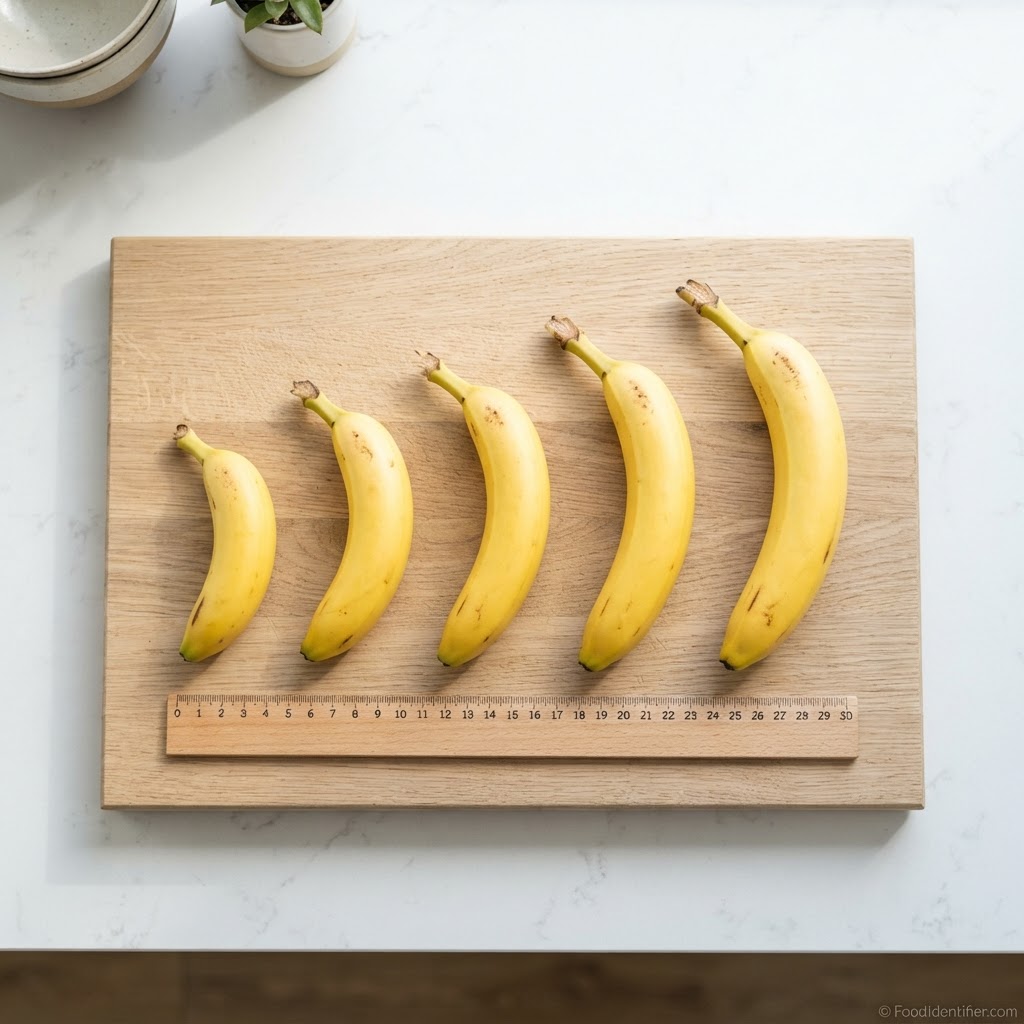
Read that table the way I do: the spread between the smallest and largest banana you're likely to pick up is 63 calories — the difference between a light snack and a small meal's worth of fruit. Neither is "wrong." Both are one banana.
A few practical notes from weighing these myself:
- ▶The medium is the reference, not the average. Supermarket Cavendish bananas skew large these days. The banana in a typical bunch at my grocery store weighs closer to 125–135g out of its skin than to 118g. If you log 105 out of habit and eat large bananas, you’re probably undercounting by 10–20 calories a day — small, but it’s exactly the kind of quiet drift people blame on a “slow metabolism.”
- ▶The peel is not part of the weight. Those gram figures are for the edible flesh. A whole in-peel medium banana weighs around 180g on the scale; the peel is roughly a third of it. If you weigh with the peel on (we all do, mid-kitchen), divide accordingly — or just peel it onto the scale’s tray like a normal person.
- ▶Half a banana is a real portion. Half a medium is about 53 calories. I mention this because bananas are one of the few fruits people routinely split — into smoothies, onto kids’ plates, across two days of oatmeal — and “half” is where logging usually gets lazy.
If you want the pure quick-reference version of this table, it's the same numbers on our banana calories answer page. What follows is everything the table can't tell you.
Not sure what size yours is? Photograph it and let the scanner estimate the portion.
Scan a food free, no app, no sign-up →Calories per 100g — the number I actually trust
A banana has 89 calories per 100g. Of every figure in this guide, this is the one I'd defend in an argument, because it's the one that survives contact with any real banana. Weigh the flesh, multiply the grams by 0.89, and you have your calories within a couple of points — whether your banana is small, large, or some unclassifiable in-between.
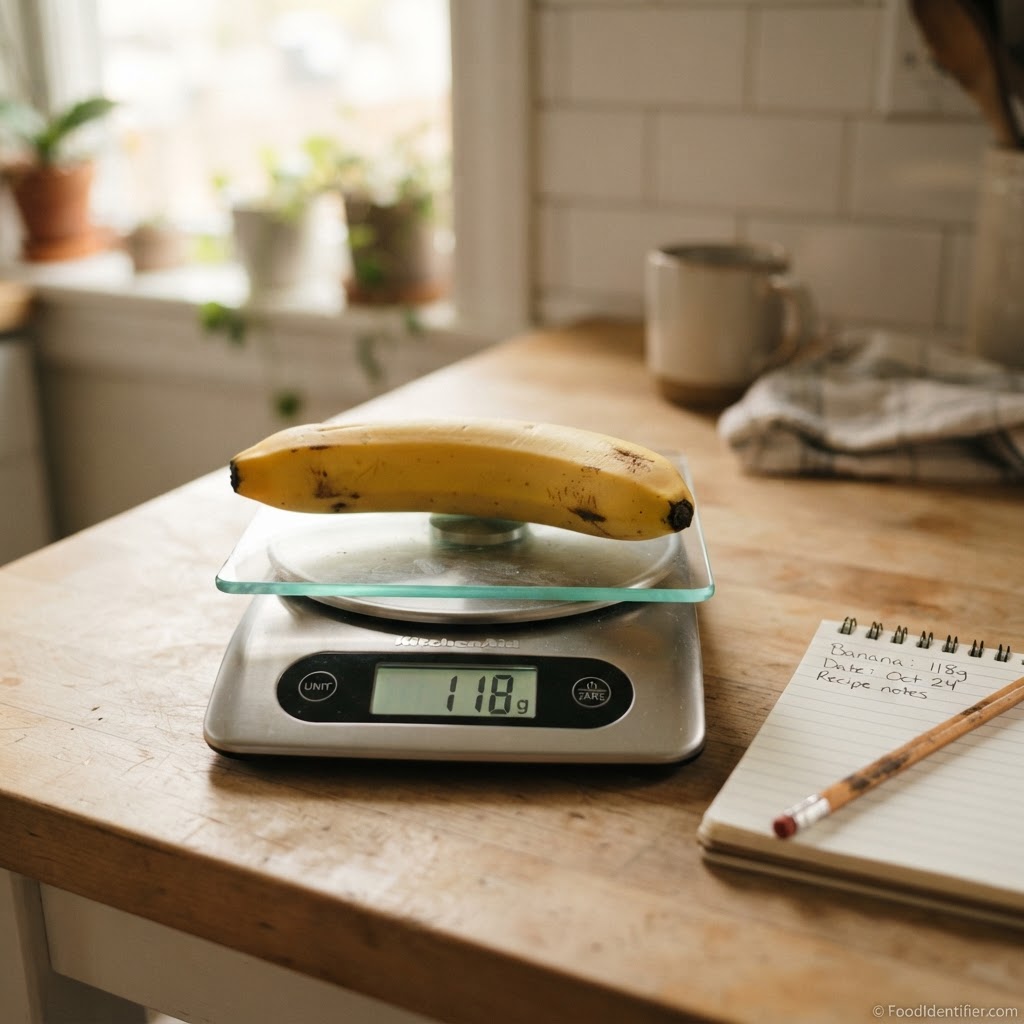
Why lead with grams instead of the length table everyone else prints? Because I kept catching the length table lying. When we were calibrating banana entries, the same "medium" label covered bananas from about 105g to 135g of flesh. That's a 27-calorie range hiding inside one word. Grams don't have that problem. A cheap kitchen scale — the one you already own, or the one that's been in the drawer since the sourdough era — settles every argument in this article in about five seconds.
How the numbers in this guide were put together
- ▶One source, stated openly — every calorie, protein and carb figure here comes from USDA reference data for raw Cavendish bananas; where a range is more honest than a point value (ripeness especially), I give the range and say so.
- ▶Weighed sizes, not vibes — the size table uses the USDA’s standard weighed size categories, and the per-100g figure is the anchor everything else is checked against.
- ▶No fake precision — ripeness, variety and growing conditions nudge real bananas a few percent either way. Anyone quoting you a banana at “104.6 calories” is performing accuracy, not practicing it.
- ▶Scanner cross-check — I run the fruits in this guide through our own scanner the same way a reader would, and where a photo estimate and the weighed value disagree, the weighed value wins and I say why.
The full nutrition table: what's actually in a banana
Calories get the headline, but here's the whole picture — per 100g, and for the medium banana (118g) most people mean.
| Nutrient | Per 100g | Medium banana (118g) |
|---|---|---|
| Calories | 89 kcal | 105 kcal |
| Protein | 1.1g | 1.3g |
| Carbohydrates | 22.8g | 27g |
| Fiber | 2.6g | 3.1g |
| Sugars | 12.2g | 14.4g |
| Total fat | 0.3g | 0.4g |
| Potassium | 358mg | 422mg |
| Vitamin C | 8.7mg | 10.3mg |
| Vitamin B6 | 0.4mg | 0.4mg |
| Magnesium | 27mg | 32mg |
| Manganese | 0.3mg | 0.3mg |
Three things in that table deserve more than a glance.
The potassium is real, but it isn't magic. A medium banana's 422mg of potassium is a solid contribution — bananas genuinely earn their reputation here. But potatoes, beans and yogurt are in the same league or ahead of it, so treat the banana as a good potassium source, not a supplement in a peel.
The fiber does quiet work. 3.1g of fiber in a medium banana is roughly a tenth of what most adults should get in a day, and it's a big part of why a banana fills you up better than 105 calories of juice or candy ever will. Fiber slows the whole thing down — the sugar arrives with company.
The fat is a rounding error. At 0.4g, a banana is effectively fat-free. Whatever role bananas play in anyone's diet, fat is not it — which is also why a banana alone doesn't keep you full for long. More on that pairing problem in the protein section.
How much protein is in a banana? The honest answer
This is the third-biggest banana question on Google, so let me be as direct as the question deserves: a medium banana has 1.3 grams of protein. Per 100g, it's 1.1 grams. A banana is not a protein food.
I say that with love. The banana's job in your diet is quick energy, fiber, potassium and convenience — it does all four brilliantly. Protein is simply not on its résumé, and pretending otherwise does nobody any favors. To put the 1.3g in perspective: you'd need to eat roughly fifteen medium bananas to match the protein in a single chicken breast, and by then you'd have eaten over 1,500 calories of banana. Nobody's meal plan survives that trade.
Where this actually matters is breakfast. "Banana and coffee" is a very common breakfast among people who then feel hungry again by 9:40 a.m. — and the protein number is exactly why. The fix isn't to drop the banana; it's to give it a partner that carries the protein it lacks:
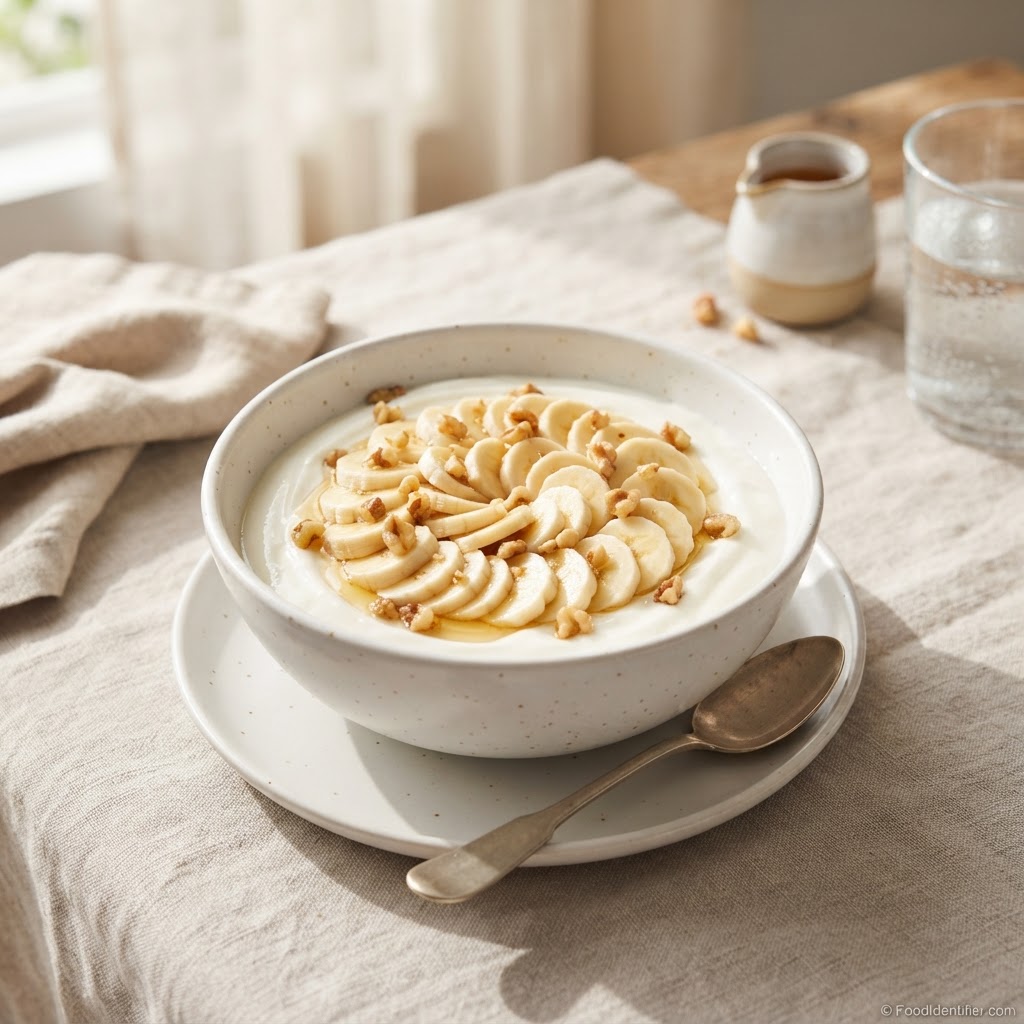
- ▶Banana + Greek yogurt — the yogurt brings the protein (a standard pot carries well into double digits), the banana brings sweetness and fiber. This is the pairing I recommend most, and the one I eat.
- ▶Banana + eggs — two eggs alongside turns a snack into a meal.
- ▶Banana in a smoothie with milk and oats — the milk and oats quietly add protein and staying power the banana alone doesn’t have.
- ▶Banana + a handful of nuts or a spoon of peanut butter — fat and a few grams of protein slow the banana’s quick carbs down.
If protein is your current project, our high-protein foods complete list is the bench the banana isn't on — and our guide to how much protein per day to lose weight does the daily-target math. The banana belongs in those plans as the energy and the enjoyment. Just don't ask it to be the protein.
Green, yellow, or covered in spots: what ripeness actually changes
Bananas are unusual among fruits in that we eat them at almost every stage of ripeness — and the stages are genuinely different foods in your hand, even if the calorie count barely moves. Here's the honest version of what changes, stage by stage.
| Stage | What it looks like | What’s happening inside | Best for |
|---|---|---|---|
| Green / unripe | Fully green peel, firm, starchy bite | Starch is high and much of it is resistant starch; sugars are low | Cooking, adding to savory dishes, the slowest energy release |
| Just ripe | Green fading to yellow, still firm | Starch is converting; sweetness building | Slicing onto cereal or toast, people who dislike soft texture |
| Fully ripe | All yellow, sweet, fragrant | Most starch has become sugar; fiber partially softened | Eating as-is — the standard snack banana |
| Very ripe | Yellow with brown spots, soft, very sweet | Sugars at their peak; texture softening | Smoothies, baking, freezing for later |
| Overripe | Mostly brown/black peel, very soft | Peak sweetness, mushy texture | Banana bread and baking — not banana failure |
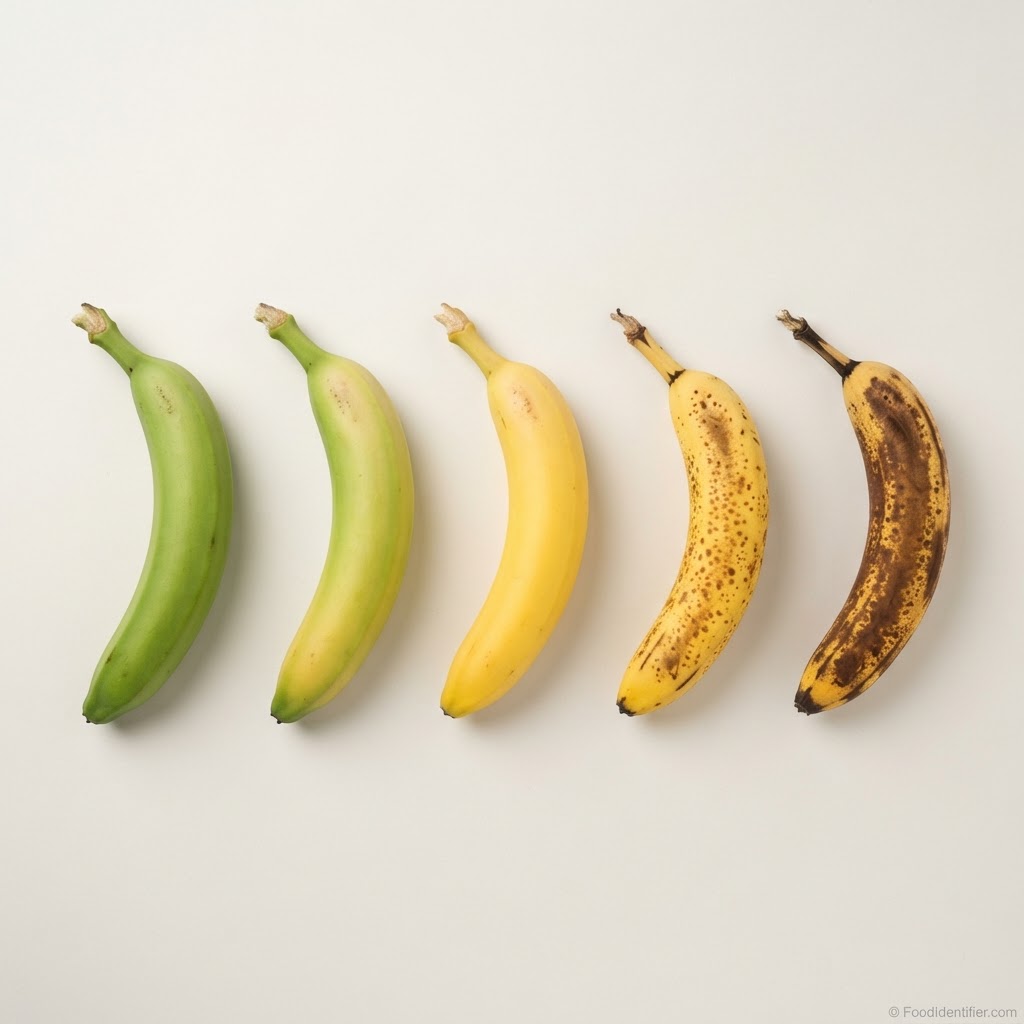
The calorie count stays roughly the same. This surprises people, so I'll say it plainly: a banana doesn't gain calories as it ripens. What changes is the form of the carbohydrates. In a green banana, a good share of the 22.8g of carbs per 100g is starch — including resistant starch, which your body digests slowly and partially not at all, so a green banana effectively delivers a little less usable energy and a gentler, slower rise. As the banana ripens, enzymes convert that starch into sugars — glucose, fructose and sucrose — which is why a spotty banana tastes dramatically sweeter even though the scales say it weighs the same. By the fully ripe stage, sugar makes up about 12.2g of every 100g. Same banana, same rough calorie total, faster fuel.
A few honest consequences of that:
- ▶Sweetness is a ripeness dial, not a variety. If bananas taste “too sweet” to you, you may simply be eating them a stage later than you’d like. Buy them greener than you think.
- ▶The greener the banana, the slower the energy. Green and just-ripe bananas digest more slowly — relevant for the blood-sugar discussion below, and the reason green bananas show up in conversations about resistant starch and gut health.
- ▶Brown spots are not spoilage. A spotty banana is at peak sweetness and is the best banana in the bunch for baking and smoothies. The black-peel stage is where flavor peaks and texture gives up — use it or freeze it, don’t bin it.
- ▶Freezing stops the clock. Peel very ripe bananas, freeze them in chunks, and the sugar and calories stay exactly where they froze. Blended from frozen, they make the base of half the “healthy ice cream” recipes on the internet — at which point the calorie count depends on what else you blend in, not the banana.
I won't put fake numbers on the stages. Anyone who tells you a green banana has exactly X fewer calories than a yellow one is inventing precision the fruit doesn't offer — the honest statement is the one above: total calories roughly constant across ripeness, sugar share rising, resistant starch falling, usable energy a touch lower at the green end.
Banana vs apple vs orange vs grapes: the honest comparison
Bananas don't compete with other bananas at the grocery store — they compete with whatever else is in the fruit bowl. Here's the per-100g comparison using standard USDA values, because per-100g is the only fair way to compare fruits nobody eats in equal weights.
| Fruit (per 100g) | Calories | Protein | Carbs | Fiber | Sugar | Potassium |
|---|---|---|---|---|---|---|
| Banana | 89 kcal | 1.1g | 22.8g | 2.6g | 12.2g | 358mg |
| Apple | 52 kcal | 0.3g | 13.8g | 2.4g | 10.4g | 107mg |
| Orange | 47 kcal | 0.9g | 11.8g | 2.4g | 9.4g | 181mg |
| Grapes | 69 kcal | 0.7g | 18.1g | 0.9g | 15.5g | 191mg |
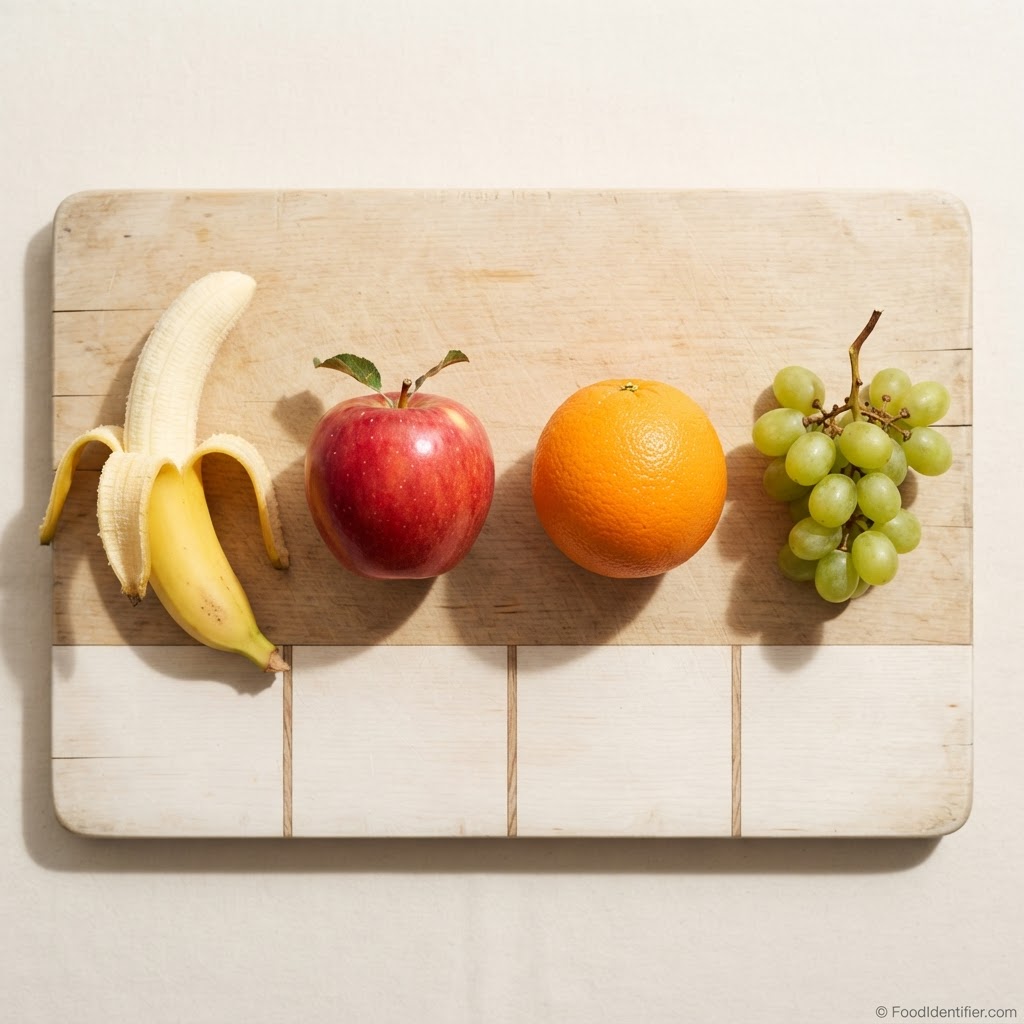
And because "best" depends on the job, here are the labels the table actually supports:
- ▶Banana \u2014 best for portable energy and potassium. It’s the most calorie-dense fruit on this list, which is a feature if you’re fueling a run or a kid’s afternoon, and a thing to notice if you’re not. It also wins on potassium by a distance.
- ▶Apple \u2014 best for volume per calorie. At 52 kcal per 100g with real fiber and crunch, an apple lets you eat a lot of fruit for not many calories. Drawback: the protein and potassium numbers are the weakest here.
- ▶Orange \u2014 best for the lightest full-fruit option. Lowest calories on the table and the fiber survives better in a whole orange than in any juice. Drawback: peeling is apparently a barrier for humanity; the banana solved that one.
- ▶Grapes \u2014 best for sweetness per bite — and the easiest to overeat. Highest sugar here, lowest fiber, and they disappear by the handful without ever feeling like a portion. Drawback: nobody has ever eaten exactly 100g of grapes on purpose.
The verdict I'd actually give a friend: the banana is the most substantial snack on this list — more calories, more carbs, more potassium, more filling. That's neither good nor bad until you know what the snack is for. Before a workout, it's the best choice here. As an idle desk snack on a day you're trying to keep light, the apple or orange does the same job for roughly half the calories per 100g.
Bananas and weight loss: what I'd tell a friend
Let's get the two loud claims out of the way first. Claim one: "bananas are fattening." Claim two: "bananas burn belly fat." Both are nonsense, and they're nonsense in opposite directions. A banana is 105 calories of fruit with fiber. It has never made anyone gain weight by itself, and it has never melted anything.
Here's the case as it actually stands.
Where bananas help. A medium banana is one of the more filling 105-calorie snacks available — the fiber and the sheer chew time see to that, and it outperforms the 105-calorie alternatives people actually reach for (a small packet of crackers, half a cereal bar, a few mouthfuls of juice). It's also portable, needs no prep, no fridge and no washing, which sounds trivial until you realize convenience is the single biggest predictor of whether a snack plan survives a busy week. A slightly-less-perfect snack you actually eat beats the perfect one that stays theoretical.
Where bananas quietly cost you. Two places. First, size drift — the 135-calorie extra-large logged as a 105 "medium," three or four days a week, is a real if modest leak. Second, the banana's entourage: banana bread, banana muffins, banana pancakes, the smoothie with banana plus honey plus oats plus peanut butter. The banana takes the blame for dishes where it's the lightest ingredient in the room. Log the dish, not the fruit.
When to eat one, practically:
- ▶Before exercise — this is the banana’s finest hour. Quick carbs, potassium, zero digestion drama, eaten 30–60 minutes before a run or a session.
- ▶At breakfast, with protein — banana plus Greek yogurt or eggs is a complete, satisfying start; banana alone is a countdown to the 9:40 a.m. snack drawer.
- ▶As the planned snack — a banana instead of the vending machine is a trade that wins almost every time. A banana <em>in addition to</em> the vending machine is just more food.
- ▶Greener, if you\u2019re grazing — a just-ripe banana digests slower and satisfies longer than a spotty one eaten at the same calories.
And the portion-honesty paragraph, because every weight-loss section owes you one: if you eat two large bananas a day, that's about 240 calories — completely fine inside most people's budgets, and worth knowing rather than assuming. Weight loss runs on totals, and the banana is an easy food to keep honest about precisely because it comes in its own packaging with a countable size. Weigh one once, learn what your bananas run, and the question is answered for good. If you're sorting out the protein side of a deficit, cottage cheese is the food our readers keep landing on — the banana's natural partner, and the mirror image of it nutritionally.
Bananas and diabetes: the careful, honest version
If you manage blood sugar, "can I eat a banana?" is a real question and it deserves better than either "fruit is natural, go ahead" or "bananas are sugar bombs, never." Here's the middle, which is where the truth lives.
A medium banana carries 27g of carbohydrates, of which about 14.4g is sugar. That's a meaningful carb load — roughly comparable to two slices of bread — and it will raise blood sugar. Bananas generally sit in the moderate range for glycemic impact, and where yours lands depends heavily on the ripeness stage described above: a green or just-ripe banana, with more resistant starch and less free sugar, digests measurably slower than a soft, spotty one. Same fruit, same calories, different speed.
The practical points that follow from the numbers:
- ▶Ripeness is your main lever. Greener bananas are the gentler choice; save the spotty ones for baking.
- ▶Smaller is a legitimate strategy. Half a medium banana is about 13–14g of carbs — a portion many people fit into a meal plan more easily than a whole large one.
- ▶Never send a banana in alone. Eating it with protein or fat — Greek yogurt, nuts, cheese — slows the glucose rise compared with a banana on an empty stomach.
- ▶The whole fruit beats every processed form. Juice, smoothies with added sugar and sweetened banana chips all remove or outrun the fiber that makes the whole fruit manageable.
This is general nutrition information to discuss with your care team, not a personal recommendation. This is not medical advice — talk to your doctor.
Questions people ask before they trust a banana again
“Isn’t banana sugar just as bad as candy sugar?”
Chemically, sugar is sugar — but delivery matters. A banana’s 14.4g of sugar arrives packaged with 3.1g of fiber, a potassium load and a food that takes time to eat and digest. Candy delivers its sugar fast, alone, and usually in larger amounts before you notice. The honest answer is that the sugar counts, and the package it arrives in counts too.
“Will eating a banana at night make me gain weight?”
No food has a clock. Weight change runs on your total intake over days and weeks, and a 105-calorie banana at 9 p.m. is the same 105 calories it was at 9 a.m. If a banana before bed replaces a larger dessert, the trade favors you; if it’s added on top of everything else, it’s simply added — true of any food.
“Are bananas too high in carbs for a low-carb diet?”
For strict low-carb and keto eating, honestly, yes — 27g of carbs in a medium banana can be most or all of a day’s allowance, and no framing changes that. For moderate low-carb eating, a small or half banana fits some budgets. This is one question where the banana has to concede.
“My bananas always go brown before I eat them. Am I wasting money?”
You’re wasting an opportunity, not money. Spotty bananas are peak-sweetness baking and smoothie fruit, and peeled-and-frozen chunks keep for months as a ready ingredient. The fruit bowl’s saddest banana is usually its most useful one.
The banana in other forms: frozen, dried, baked
Frozen banana — nutritionally, it's the same banana. Freezing changes texture, not the calorie or sugar content, so a medium frozen banana is still about 105 calories whether you blend it, slice it over yogurt or eat it in chunks like a skeptical toddler. It's the one "processed" form that changes nothing.
Dried banana and banana chips — a different food, and the numbers prove it. Banana chips are typically fried, and they run around 520 calories per 100g — nearly six times the fresh fruit per gram — because the water is gone and oil took its place. Sweetened dried banana isn't far behind conceptually: concentrated sugar, small handfuls, big totals. Enjoy them as what they are — a treat in the chips family — not as a portable health food.
Banana bread and muffins — the banana is the best thing in them, which is exactly the problem with judging them by it. Butter, sugar and flour set the calorie count, and a generous bakery slice lands in full-dessert territory. Homemade versions give you the steering wheel — less sugar, some wholegrain flour — but even then, log the slice as cake's close cousin, not as fruit. If you want to know where a specific slice lands, scan it rather than guessing from the name.
How FoodIdentifier's scanner reads a banana
Bananas are one of the friendliest foods a photo scanner can meet: a shape nothing else has, a color that announces ripeness, and usually a single countable portion. When you photograph one in FoodIdentifier, here's what actually happens. The scanner identifies the fruit, estimates its size from the proportions in the photo — a banana next to a plate, a hand or a table edge gives it scale to work with — and matches that estimated portion against reference nutrition of exactly the kind in this article: medium at 105, scaled up or down by the estimated weight.
Two things improve the estimate, and they're both in your hands. First, shoot the banana next to something of known size — your hand works fine. Second, peel state matters: a photo of a whole in-peel banana includes a peel that makes up roughly a third of the whole fruit's weight, and the scanner accounts for the edible portion rather than billing you for the skin.
And the honest limitation, because every scanner page should have one: a photo estimates portion; it doesn't weigh it. On a banana the estimate is usually close — the shapes are consistent — but if you're counting tightly, thirty seconds on a kitchen scale still beats any photo, ours included. The scanner's job is the 95% of moments when there's no scale, no label and no time — the banana on a train, the bunch at a market stall, the snack you're about to eat at your desk.
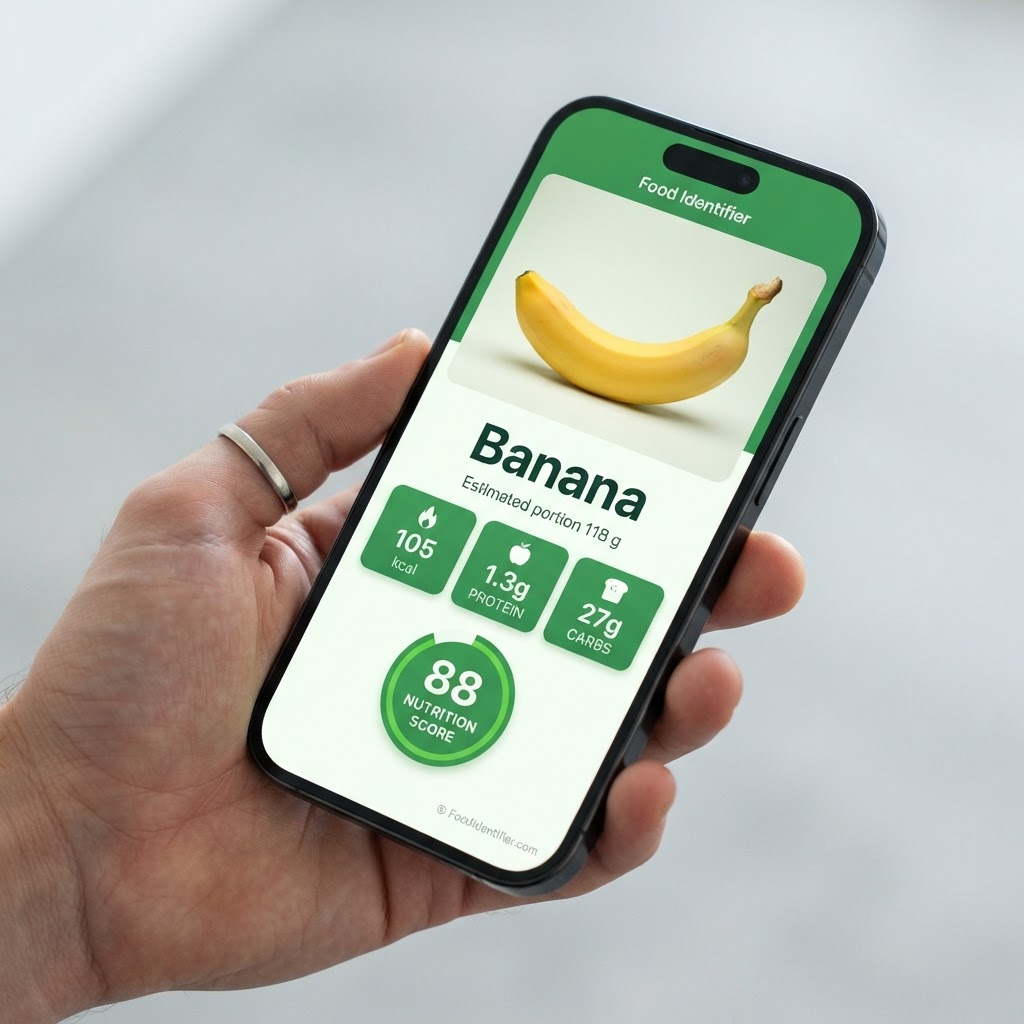
"Crispy Does NOT Mean Healthy" — a real scan in action, from our YouTube channel.
Photograph any food and see its calories and macros in seconds — scan a food free, no app, no sign-up.
Photograph any food free →Which banana, for which job?
- ▶Fueling a workout in the next hour: a fully ripe medium banana — fast carbs, gentle on the stomach, about 105 calories of go.
- ▶A light desk snack inside a tight budget: a small banana (90 calories) or half a large one — all of the ritual, a friendlier total.
- ▶Cooking or a savory dish: green and firm — it holds its shape and behaves more like a starchy vegetable than a fruit.
- ▶Blood-sugar-conscious snacking: just-ripe, on the smaller side, and paired with protein or fat rather than eaten alone.
- ▶Baking, smoothies and freezing: the spottiest banana you own. Sweetness peaks here; this is what they’re for.
- ▶Protein is the goal today: honestly, not a banana question \u2014 pair it with yogurt, eggs or cottage cheese, or pick from the high-protein list and let the banana be dessert.
Sources
Every figure in this guide comes from USDA reference data for raw Cavendish bananas (89 calories, 1.1g protein, 22.8g carbohydrates, 2.6g fiber, 12.2g sugars and 358mg potassium per 100g), with comparison values from the same source for apples, oranges and grapes; figures checked November 2026. Individual bananas vary a few percent with variety, ripeness and growing conditions — which is why the weighed per-100g figure is the anchor throughout.
FAQ
Scan a food free — no app, no sign-up — and see the calories, protein and carbs for the exact portion on your plate.
Scan a food free — no app, no sign-up →Scan from a Photo →About the author
Faisal Ali — Founder of FoodIdentifier
Faisal Ali is the founder of FoodIdentifier, the free AI food scanner. He weighs bananas so you don't have to — and writes the plain-numbers guides he'd want before trusting any food database, from Dallas, Texas.
Related reading: the one-line banana answer, how much protein per day to lose weight, and is cottage cheese healthy?
Connect with Faisal on LinkedIn →This article is general nutrition information only. This is not medical advice — talk to your doctor. Nutrition figures are USDA reference values for the servings stated; individual bananas vary with size, variety and ripeness, so weigh yours when the number really matters. Last updated November 3, 2026.