 FoodIdentifier
Are Protein Bars Actually Healthy? The 60-Second Label Test
Some protein bars are genuinely useful. Others are candy bars wearing a gym costume. Here's the four-check label test that tells them apart — in sixty seconds, no nutrition degree required.
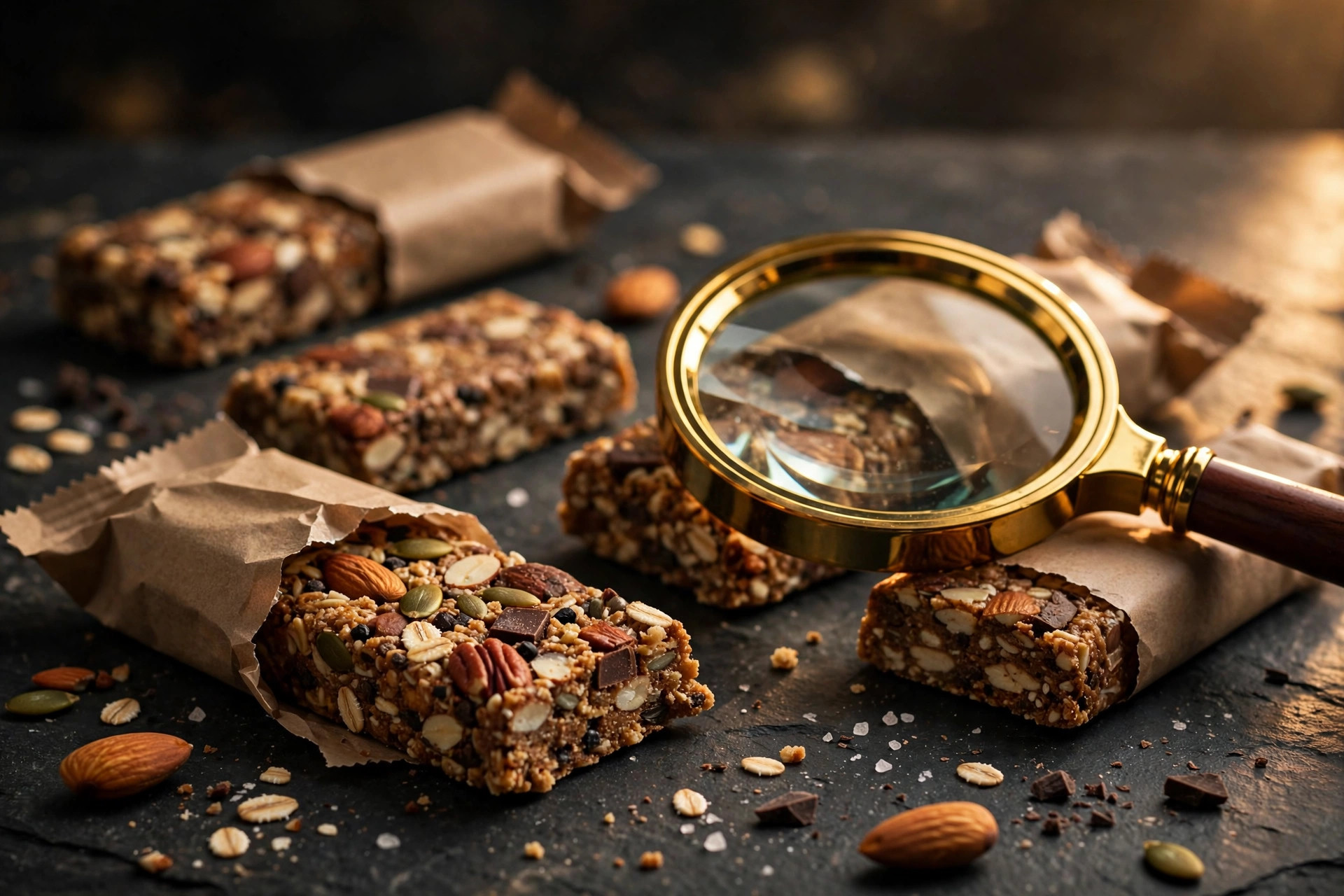
Scan any bar's barcode free at FoodIdentifier.com — instant health verdict, no app, no sign-up.
Scan any bar's barcode free at foodidentifier.com and get the verdict in seconds. No app, no sign-up, no card.
Scan a Barcode Free →Scan the Label Instead →The protein bar aisle is a masterclass in confusion. Every wrapper screams PROTEIN in giant letters while whispering the rest in 6-point font. Some of these bars are genuinely useful — 20 grams of protein, reasonable sugar, real food ingredients. Others are candy bars wearing a gym costume: 300 calories, 25 grams of sugar, and a dusting of protein powder for plausible deniability. So are protein bars actually healthy? Some are, many aren't — and the wrapper won't tell you which is which.
You don't need a nutrition degree to tell them apart. You need 60 seconds and four checks. Here's the label test.
⚡ The Short Answer
Some are, many aren't. A good bar delivers 10g+ protein per 100 calories, under 5g of added sugar, and 3g+ fiber — a bad one is a candy bar with protein powder. Check the ratio, the added-sugar line, and the ingredient red flags. Or skip the math and scan any barcode free at foodidentifier.com.
⚠️ Medical Disclaimer
This article is for educational purposes only and is not medical advice — talk to your doctor. Protein bar choices for specific medical conditions (diabetes, kidney disease, food allergies) should be discussed with a healthcare provider. Calculator results are estimates.
Why the Protein Bar Question Exists: The Candy-Bar Problem
Protein bars were invented for athletes who needed portable fuel. Then the protein craze hit, and every snack company realized the same thing: put "PROTEIN" on the wrapper and health-conscious shoppers will pay $3 for what is essentially a Snickers with whey isolate.
The trick is in the framing. A bar can legally advertise "20g PROTEIN" while containing 28g of sugar — because the protein claim is true and the sugar is just... there, in small print. Your brain files it under "gym food." Your blood sugar files it under "dessert."
This isn't to say all bars are junk. The category spans from genuinely excellent to genuinely terrible, and the wrapper won't tell you which is which. The label will — if you know the four checks.
The 60-Second Protein Bar Label Test (4 Checks)
Flip any bar over and run these in order. Sixty seconds, no calculator needed.
Check 1: Protein per 100 calories (the only math that matters)
Divide protein grams by calories, roughly. You're looking for at least 10g of protein per 100 calories — a 200-calorie bar should carry 20g of protein.
- ▶Pass: 200 cal / 20g protein. That's real food doing real work.
- ▶Fail: 280 cal / 12g protein. That's a candy bar with aspirations.
- ▶Elite: 190 cal / 21g protein with 1g sugar. These exist — they're just not the ones with the flashiest wrappers.
Why this ratio beats "total protein": a 350-calorie bar with 20g protein sounds fine until you realize you could've eaten a chicken breast (300 cal, 50g+ protein) for the same calories. The ratio keeps bars honest.
Check 2: The 5-gram added-sugar rule
Look at "Added Sugars" on the label (it's a separate line from total sugars — that's the one that matters). Under 5g: fine. 5–10g: acceptable if everything else is great. Over 10g: it's dessert.
Watch for sugar's aliases in the ingredients: brown rice syrup, tapioca syrup, agave, "evaporated cane juice," maltitol, dextrose. If the first three ingredients include two syrups, the "protein bar" is a candy bar regardless of what the front says.
One nuance: sugar alcohols (maltitol, erythritol, xylitol) aren't counted as added sugar, but maltitol still spikes blood sugar in many people and causes digestive distress in large amounts. A bar sweetened mostly with maltitol isn't the win the label implies.
Check 3: The fiber floor (3g minimum)
Fiber is the difference between a bar that satisfies you for three hours and one that leaves you hungry in forty minutes. Look for at least 3g; 5g+ is excellent. Fiber slows digestion, blunts the sugar response, and actually makes the bar function as a meal replacement rather than a snack that demands a follow-up snack.
Beware the fiber trick: some bars pump up fiber with isolated fibers (soluble corn fiber, tapioca fiber) that don't behave like food fiber. They're not harmful, but they're not the same as the fiber in oats or nuts.
Check 4: Ingredient red flags (the 10-second scan)
Glance at the ingredient list. You're not reading every word — you're hunting:
- ▶Palm oil / palm kernel oil as a main fat: cheap filler, the reason the "chocolate coating" doesn't melt.
- ▶"Protein blend" without specifics: fine, but "whey protein isolate" or "milk protein isolate" first is better than "soy protein" buried fifth.
- ▶More than 15 ingredients: not automatically bad, but a bar with 25 ingredients is a chemistry project, not food.
- ▶Artificial colors: there's no reason a protein bar needs Red 40. Its presence tells you everything about the manufacturer's priorities.
Protein Bar Scorecard: Healthy, Okay, and Candy in Disguise
When a Protein Bar Makes Sense (and When It Doesn't)
Genuinely useful: post-workout when real food is an hour away; travel days and airports; the 3pm desk drawer instead of the vending machine; hiking or long shifts where meals are impossible. A good bar in these moments beats the alternative by a mile.
Not useful: as a daily "health snack" when you have a kitchen — real food wins on every metric; as dessert replacement when you'd be happier with actual dessert (eat the dessert, enjoy it, move on); as a protein source when you haven't checked the ratio (see the candy-bar problem above).
The honest hierarchy: a real meal > a good bar > a bad bar > nothing > a bad bar you thought was healthy. The last one is the only true trap — not the calories, but the false confidence.
Scan the Barcode Instead: The Zero-Effort Version
Here's the thing about the 60-second test: it works, but you have to remember it, in a grocery aisle, while your ice cream melts. There's a lazier option that never forgets.
Point your phone camera at the barcode. The barcode scanner pulls the product, runs the equivalent of all four checks instantly, and gives you a plain-English verdict: the health score, the top watch-outs (added sugar, sodium, ultra-processed flags), and two better alternatives if this one fails.
It also works on the nutrition label itself — photograph the label and OCR reads it directly. Sixty seconds becomes five. The test in this article teaches you the principles; the scanner applies them when you're standing in aisle seven with melting ice cream.
Scan the barcode free at foodidentifier.com — verdict in 5 seconds, no app, no account, no card.
Scan This Bar Free →FAQ — Protein Bars
Scan any bar's barcode free at foodidentifier.com and get the verdict in 5 seconds.
No app, no account, no card.
👉 Scan Free at FoodIdentifier.com →Check Your Protein Target →📚 Related Tools & Guides
Related Searches