Home › Blog › AI Nutrition Coach
AI Nutrition Coach: Voice, Memory and Personalized Meal Plans (2026)
Most people know roughly what they should eat. The problem is figuring out how much, when, and in what combination to actually hit their goals. A registered dietitian can answer those questions perfectly — but appointments take weeks to book, cost a lot, and happen maybe once a month. What if you could get that same quality of personalized guidance instantly, any time of day, completely free?
That is exactly what an AI nutrition coach online does. FoodIdentifier built one that goes beyond generic advice: it uses voice conversations, remembers your preferences, reacts to your food photos and barcode scans in real time, and generates full meal plans around your specific calorie and macro targets. This guide explains everything it does, who it is best for, and how to get the most out of it.
⚡ Quick Answer — What Does the AI Nutrition Coach Do?
- Answers nutrition questions instantly, 24/7 — no appointments needed
- Generates personalized meal plans based on your calorie goal, diet type, and allergies
- Reacts to food photos and barcode scans with immediate feedback
- Supports voice input and output for natural, hands-free conversations
- Remembers your preferences and goals across sessions
- Covers weight loss, Ozempic/GLP-1 support, gym macros, and blood sugar awareness
Start Your $1 Trial Today
Try the AI nutrition coach free. Voice, memory, meal plans, and more for 7 days.
Try AI CoachWhat Is an AI Nutrition Coach (And What It Is Not)
An AI nutrition coach is a conversational AI tool trained on nutrition science, dietary guidelines, and food data. You can ask it questions about meals, calories, macros, food swaps, and meal planning — and it responds with specific, personalized answers based on your goals and context.
The best way to understand it is to compare it to two things you already know. A search engine gives you a list of web pages about a topic. A human nutritionist gives you a personalized answer after understanding your situation. An AI nutrition coach does something closer to the second option, but instantly, any time you need it, and without the $150/session fee.
How FoodIdentifier AI Nutrition Coach Works
The coach combines a large language model trained on nutrition science, a food and calorie database, and real-time scan inputs (photo and barcode). Here is exactly how the experience works:
- Open in your browser — Go to foodidentifier.com/Ainutritioncoach — no app download, no account. Works on iPhone, Android, tablet, and desktop.
- Tell the coach your goal — Type or say your health goal: weight loss, muscle gain, Ozempic support, blood sugar awareness, or just eating better.
- Ask a question or scan food — Ask anything: what to eat for breakfast, whether a food fits your macros, how to hit your protein target. Or scan a meal photo or barcode for instant analysis.
- Get a personalized response — The coach replies with specific advice — not generic tips, but answers that factor in your goal, dietary type, calorie budget, and previous conversation.
- Request a full meal plan — Ask it to build a complete daily meal plan with breakfast, lunch, dinner, and snacks. It customizes around your calorie goal, dietary restrictions, and taste preferences.
- Enable voice mode — Turn on the microphone to talk instead of type. The coach listens, understands your question, and responds with both text and voice output.
Best Use Cases: Weight Loss, Ozempic, Macros, Blood Sugar
The AI coach adapts to specific goals and circumstances. Here are the four areas where people find it most valuable.
Weight Loss
The most common use case. The coach helps you understand your calorie deficit, suggests filling low-calorie meals, and gives you real-time feedback on whether a food fits your daily budget. For a data-backed starting point, use the Calorie Deficit Calculator to find your daily deficit target, then bring that number to the AI coach for meal planning around it.
Ozempic and GLP-1 Support
GLP-1 medications reduce appetite significantly, which creates a real challenge: you need to pack maximum nutrition into very small portions. The coach specializes in high-protein, low-nausea meal suggestions for users on Ozempic and similar medications.
Gym Macros and Muscle Building
The coach calculates protein targets based on your body weight and goal, then helps you hit them across the day with specific food suggestions. Use it alongside the Macro Calculator for a complete picture.
Blood Sugar Awareness
For users managing blood sugar through diet, the coach suggests lower-glycemic alternatives, explains how carbs behave in the body, and helps plan balanced meals that avoid blood sugar spikes. This is educational information — not medical advice for diabetes management.
Voice Conversations: Talk Like a Real Person
One feature that sets this apart from a simple nutrition coach chatbot is voice. Most people do not want to type a paragraph about what they just ate while standing in a kitchen. With voice mode, you press the microphone button, say your question naturally, and the coach responds — both in text and with spoken audio.
This makes it genuinely hands-free. You can ask "is this chicken breast cooked enough protein for dinner?" while doing the dishes. Or "what should I eat before my morning run tomorrow?" on your commute. Privacy note: voice input is processed for the duration of your question and is not stored.
Personalized Meal Plans That Adapt Daily
Generic meal plans from nutrition websites are built for an average person with average goals. The AI coach builds plans for you specifically. Tell it your calorie target, dietary type (keto, Mediterranean, vegan, high-protein), allergies, foods you dislike, and how many meals you want per day. It generates a complete plan with breakfast, lunch, dinner, and snacks.
For users who cook at home often, the Calories in Homemade Food guide explains how to estimate and track calories in your own recipes alongside the AI meal planner.
Macro Coaching for Gym Users and Beginners
Macros — protein, carbohydrates, and fat — are the foundation of any nutrition plan, whether your goal is muscle gain, fat loss, or athletic performance. The AI macro coach calculates your daily targets based on your body weight, activity level, and goal. If you want to build muscle, it pushes protein to around 0.7–1g per pound of body weight and adjusts carbs for training fuel.
Once your targets are set, the coach helps you hit them food by food. For the math behind your targets, the Macro Calculator Guide is the best place to start.
Ozempic and GLP-1 Meal Support
If you are on semaglutide, tirzepatide, or another GLP-1 medication, you already know that your relationship with food changes significantly. Appetite suppression is strong, nausea is a real side effect for many people, and eating enough protein becomes genuinely challenging when you can only eat small amounts.
The AI coach understands these constraints. When you tell it you are on a GLP-1 medication, it shifts its recommendations toward high-protein, small-portion foods that are easy to digest (Greek yogurt, eggs, cottage cheese, soft fish).
Food Photo and Barcode Feedback: Which Is More Accurate?
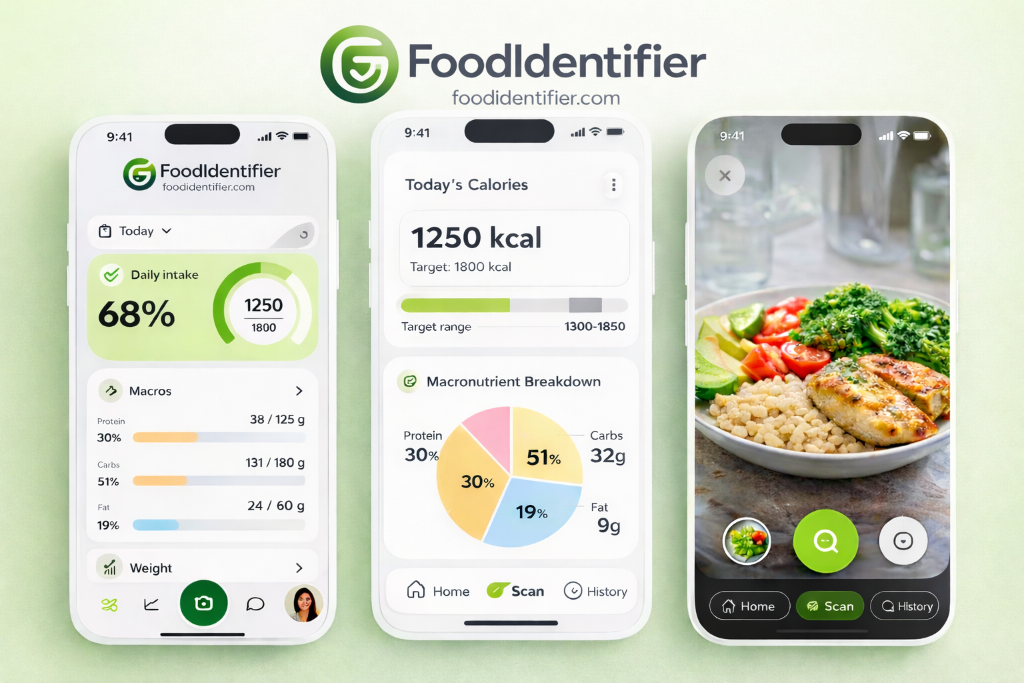
One of the things that makes this different from a pure nutrition coach chatbot is that it is directly connected to a food scanner. When you scan a meal with your camera or a product with its barcode, the coach reacts to that specific food — not a generic version of it.
Try the food photo scanner or the barcode nutrition scanner directly from your phone.
Real Conversation Examples
The best way to understand what talking to this coach actually feels like is to see some real exchanges. These are typical conversations that users have every day.
👤 "I just scanned my burrito at Chipotle. Is this too many calories for lunch if I am trying to lose weight?"
👤 "Should I drink this protein smoothie after my morning workout? I scanned it and it shows 25g protein."
Why This Beats Traditional Apps and Human Coaching
There are plenty of nutrition apps and services out there. Here is how FoodIdentifier's AI nutrition coach compares to the most popular alternatives:
Who Should Use an AI Nutrition Coach
Not everyone needs the same level of nutrition support. Here is a breakdown of who gets the most value:
- Beginners: Just starting their health journey who need guidance on calories, macros, and balanced eating
- Busy professionals: Eat most meals out or travel often and need fast, practical advice
- Ozempic users: Need to maximize nutrition in small portions and minimize side effects
- Gym users: Building muscle or cutting fat who want to understand protein targets and hit macros
- Blood sugar awareness: Want practical, low-glycemic meal suggestions and education
- Tracking avoiders: Find calorie logging exhausting and prefer conversational guidance
Accuracy, Safety, and Disclaimer
Nutrition AI is useful precisely because it removes friction — but it is important to understand where estimates come from and what their limits are.
Related Tools and Guides
Frequently Asked Questions
❓ Is there a free AI nutrition coach online?
Yes. FoodIdentifier offers a free AI nutrition coach that you can start chatting with directly in your browser — no account or app needed. A $1 trial unlocks premium features like voice conversations, memory, and unlimited chat.
❓ Can the AI nutrition coach generate meal plans?
Yes. You can ask it to create a personalized meal plan based on your calorie goal, dietary type (keto, vegan, high-protein, etc.), allergies, and schedule. It generates full-day plans with breakfast, lunch, dinner, and snacks.
❓ Does the AI coach remember my preferences?
Yes. Once you set up a profile, the coach remembers your dietary type, health goals, allergies, macro targets, and previous conversations. It gets more accurate and personalized over time.
❓ Can I talk to the AI nutrition coach by voice?
Yes. The coach supports both voice input and voice output. You can speak your questions naturally and hear the coach respond out loud — just like a real conversation with a nutritionist.
❓ Can it help with Ozempic or GLP-1 meal planning?
Yes. Many users on Ozempic or other GLP-1 medications use the coach to find high-protein, low-nausea meals that work well on smaller portions. This is educational guidance, not medical advice — always follow your doctor's instructions.
❓ How accurate are the AI food photo scans?
Photo scans are visual estimates with roughly 80-90% identification accuracy for common foods. Calorie estimates may vary by 10-20% depending on portion size, lighting, and hidden ingredients like sauces and oils. Barcode scans pull directly from nutrition labels and are more precise for packaged foods.
❓ Are barcode scans more accurate than photo scans?
Yes. When you scan a product barcode, the AI retrieves nutrition data directly from the product's label data, which is much more reliable than estimating from a photo. Use photo scans for restaurant meals and homemade food; use barcodes for packaged products.
❓ Can the AI coach help me lose weight?
Yes. The AI weight loss coach helps you understand your calorie deficit, macro balance, and food choices daily. It does not replace a doctor or dietitian, but it gives you practical, data-informed guidance at any time of day.
❓ What is the difference between this and MyFitnessPal?
MyFitnessPal is a manual food logging database. FoodIdentifier's AI nutrition coach is a conversational coach that actively advises you, reacts to your scans, generates meal plans, and adapts to your goals — without requiring you to manually look up and log every item.
❓ Can it help with macro tracking for the gym?
Yes. You can ask the coach to calculate your protein, carbs, and fat targets based on your weight, goal (muscle gain or fat loss), and activity level. It then helps you hit those targets with specific food suggestions and portion guidance.
❓ Is the AI nutrition coach medical advice?
No. The AI coach provides educational nutrition guidance and general wellness information. It is not a substitute for professional medical advice, diagnosis, or treatment. Always consult a qualified healthcare provider for medical decisions.
❓ What languages does the AI nutrition coach support?
The coach currently supports English, Spanish, Portuguese, German, French, and Italian — with full voice and text capabilities in all six languages.
Disclaimer: Nutritional values and guidance are estimates based on AI analysis and reference data including USDA FoodData Central. FoodIdentifier is an educational tool and does not provide medical advice, diagnosis, or treatment. Consult a registered dietitian or physician for clinical nutrition management.