Home › Blog › Calorie Guess Game Review
Calorie Guess Game: I Learned Calorie Counting in 2 Weeks (And You Can Too)
- The Calorie Guess Game is a free calorie counting game online that trains portion size awareness through visual food guessing.
- It helps anyone — beginners, parents, fitness enthusiasts — learn calorie counting fast through daily 10–15 minute sessions.
- Completely free. No sign-up. No app download. Works in any browser.
- Most players see measurable improvement in calorie portion guessing within 2 weeks.
- Built for calorie awareness training — not as a substitute for medical nutrition advice.
Purpose: Calorie awareness training · Author: FoodIdentifier Community Member
Disclaimer: Educational use only. Not medical advice. Results vary by individual.
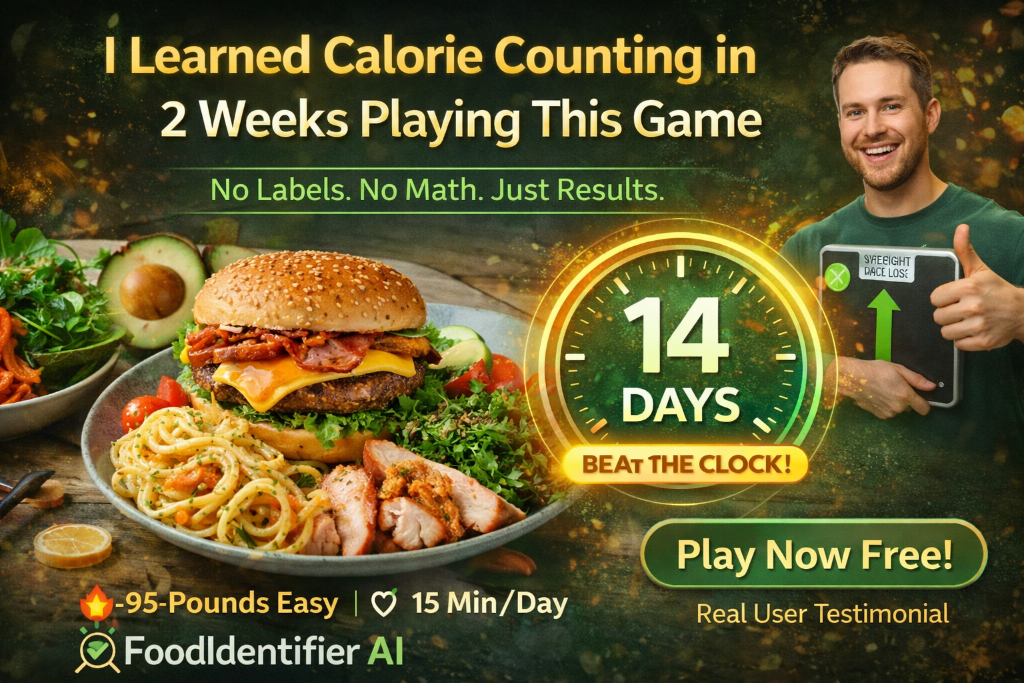
Look, I'll be honest with you. When my doctor told me to "start counting calories," I almost laughed. Me? Spend hours reading nutrition labels and weighing chicken on a kitchen scale? Yeah, right.
But here's the thing — I actually needed to lose weight. So I did what any stubborn person would do: I looked for the laziest possible way to learn calorie counting fast. That's when I found the Calorie Guess Game — a free calorie game online where you look at food photos and guess the calories.
This simple visual game shows real food photos and challenges you to estimate the calorie count before revealing the answer. Sounds simple, right? I thought so too. But after playing for just 2 weeks, something clicked. I could look at restaurant meals and know — not guess, but know — approximately how many calories I was about to eat.
This isn't sponsored content. I'm just a regular person who stumbled onto the easiest on-ramp to nutrition I've ever found. If you'd rather skip the guessing and scan a real meal right now, the AI Calorie Calculator gives instant nutrition breakdowns from a photo — no signup. Here's exactly what happened with me.
What Is the Calorie Guess Game?
The Calorie Guess Game is a free food calorie quiz built into FoodIdentifier. You're shown a photo of a real food — restaurant meals, home-cooked dishes, snacks, fast food — and you guess the calorie count. After each guess, you see the actual number plus a full macro breakdown. It's a calorie education tool wrapped in a game format that makes learning genuinely engaging.
Unlike spreadsheets or calorie apps, there's no logging, no database searching, and no daily commitment required. It's a free calorie game online you can play for 5 minutes on your phone while waiting for coffee. That's it. And somehow, it works.
You can try it now via the Calorie Guess Game — no sign-up, no download, instant access.
How the Calorie Guess Game Works: A Free Calorie Counting Game Online

The mechanic is simple: a food photo appears, you slide or type your calorie guess, and you immediately see how close you were. Accuracy percentage builds over time. There are difficulty levels — Easy, Medium, Expert — so beginners aren't thrown into restaurant meals with complicated sauces on Day 1.
What makes this an effective calorie awareness training tool isn't the guessing itself — it's the immediate feedback. Every wrong answer comes with the correct calorie count and a macro breakdown (protein, carbs, fat). Your brain registers the gap between what you assumed and what's real, and it remembers. That's how the knowledge builds.
My actual week-by-week progression
Days 1–7: About 60% accuracy. I had no idea how many calories were in normal foods. My "healthy" smoothies turned out to be 600-calorie meals, not snacks.
Days 8–14: Accuracy jumped to 75%. Pattern recognition started kicking in — anything fried is 400+, restaurant portions double homemade, sauces are calorie traps.
Days 15–30: 85% accuracy. Started making genuinely better food choices without trying. Down 6 lbs by Day 30 — just from awareness, no strict diet.
Can a Game Really Teach Calorie Counting?
Skeptical? Fair. I was too. But the science behind it is actually solid. Spaced repetition — seeing something, getting feedback, and seeing it again — is one of the most effective learning methods. That's exactly what this calorie counting game does, just with food photos instead of flashcards.
The visual format is especially important for portion size awareness. Most people can't accurately estimate 300g of pasta from a description alone. But show them a photo of that portion next to the calorie count enough times, and the association becomes automatic. You start "seeing" calories in real food without conscious effort.
For more precise tracking alongside your game play, pair it with the AI Calorie Calculator to scan actual meals and get verified nutrition data — a great combo for serious learners.
The biggest "aha" moments that changed my eating
- A large McDonald's fries = 500 calories. For fried potato. Mind: blown.
- That "small" Starbucks muffin? 400+ calories for a "snack."
- Restaurant portions are typically 2x a standard homemade serving.
- Dressings and sauces routinely add 200–300 hidden calories to salads.
- Vegetables are basically calorie-free — eat more of them without thinking.
🎮 Play the Calorie Guess Game Free
No sign-up. No app. Start building calorie awareness in 5 minutes.
▶️ Play Free Now🔢 AI Calorie CalculatorWho Should Use a Calorie Counting Game?

Honestly? Anyone who eats food. But it's especially useful if you are:
- Trying to lose weight but find traditional calorie apps tedious — the Calorie Deficit Calculator pairs perfectly with game-based learning.
- Into fitness and need to understand macros without manual logging — complement with the Macro Calculator for precision targets.
- A parent wanting to teach kids healthy eating habits through gameplay rather than lectures.
- A beginner who wants to understand nutrition without studying — use the TDEE Calculator to find your daily calorie target once you understand the basics.
- Bad at estimating portions and tired of guessing at restaurants.
Quick Win: My 9-year-old nephew played this for one week and now points at foods saying "that's high calories" or "that's healthy protein." Kids pick this up fast because it's visual, not boring text.
Game vs Traditional Calorie Tracking Apps
Before I found this free calorie game online, I downloaded MyFitnessPal like everyone else. I used it for exactly 3 days before quitting. Logging every single meal after a long day at work felt like homework. Here's how the two approaches actually compare:
For a comprehensive tool that combines AI photo scanning with all the calculators you need, check out the All Free Health Tools page — the game and calculators work best together.
The Mistakes I Made (So You Don't Have To)
Don't skip Easy mode
I jumped to Expert mode on Day 3. Got destroyed, felt discouraged, almost quit. Stick with Easy until you're consistently hitting 80%+. Trust the process.
Play daily, not weekly
Binge-playing on Sunday doesn't work. Your brain needs daily repetition to build those associations. Even 5 minutes before bed beats a 2-hour weekend session.
Actually read the feedback after wrong answers
When you guess wrong, there's an explanation with real nutrition facts. I ignored these for the first week. Once I started reading them, my accuracy shot up immediately.

Why This Improves Portion Size Awareness
Most people have never been taught to estimate calories visually — and that's the real gap. Nutrition labels exist, but we don't eat nutrition labels. We eat plates of food, restaurant portions, and home-cooked meals where no label is present. That's exactly the gap this kind of nutrition learning game fills.
What makes this type of calorie awareness training so effective is the feedback loop. Every round you play, your brain gets a concrete reference point: "That bowl of pasta at 650 calories looks like this." Over time, those reference points stack up into genuine long-term nutrition intuition. You stop needing to calculate — you just know.
Traditional calorie counting apps teach you to depend on the app. This teaches you to depend on yourself. The difference is how to estimate calories without a scale — a skill that travels with you to every restaurant, every dinner party, every work lunch where weighing your food simply isn't possible.
Think of it as healthy portion training through repetition rather than rules. Instead of memorizing that 85g of chicken breast is 145 calories, you start recognizing what a 300-calorie plate looks like versus a 700-calorie plate — purely from visual experience. It's the same way a chef develops intuition for seasoning: not from a chart, but from doing it every day.
This is also why it works for beginner calorie education better than most resources. There's no prerequisite knowledge. No need to understand macros first, or track anything first. You just play, and the visual calorie learning happens naturally in the background.
After a few weeks of calorie estimation practice, many users find they've quietly changed their eating habits — not through willpower, but through genuine understanding of what different foods actually cost them calorically.
Frequently Asked Questions
❓ Is the Calorie Guess Game free?
Yes. 100% free — no credit card, no sign-up, no trial period trap. You can start playing in under 30 seconds. There are optional premium cosmetics, but you need none of them to learn calorie counting.
❓ How long does it take to learn calorie counting with this game?
Most players start seeing real pattern recognition in Week 2 after 10–15 minutes of daily play. By Week 3–4, accuracy typically hits 80–85% for common foods. The knowledge builds gradually and sticks long-term.
❓ Can a calorie guessing game actually help with weight loss?
Calorie awareness is a major factor in food choices. When you understand what high-calorie foods look like, you naturally make better swaps without strict dieting. It is not a medical weight loss program — it builds the nutritional literacy that supports lasting change.
❓ Is the game better than traditional calorie tracking apps?
For building long-term calorie knowledge, yes — it teaches intuition rather than dependence on an app. Traditional apps require daily manual logging which most people abandon within weeks. This game builds permanent estimation skills through repetition.
❓ Can kids use the Calorie Guess Game?
Yes. It is visual and simple enough for children. Many parents use it as a casual family activity to introduce nutrition concepts through play rather than lectures.
❓ How accurate is calorie guessing after playing?
Most users go from 50–60% accuracy in Week 1 to 80–85% by Week 3–4. Consistent daily play builds the ability to estimate common restaurant and home meals within 10–15% of actual calorie counts.
❓ Do I need to keep playing forever?
No. Most players need 30–45 days of regular play to build lasting habits. After that, the knowledge stays with you. Occasional play (once a week or less) is enough to reinforce what you've learned.
❓ Does it require a sign-up or app download?
No sign-up and no app download required. It runs entirely in your browser on any device — phone, tablet, or desktop. Start immediately without creating an account.
Is It Worth Playing? Final Verdict
Listen — I'm not saying this game will change your life overnight. But if you want to understand nutrition and find traditional methods boring as hell, this is genuinely the easiest on-ramp I've found. It took me 2 weeks to go from "calorie clueless" to "I can eyeball restaurant meals." That's faster than any nutrition class or diet book ever taught me.
The kicker? I didn't have to force myself to play. It was actually fun — which is a wild thing to say about calorie education. If you've been putting off learning about nutrition because it feels overwhelming, try this for one week. You'll be shocked how quickly how to estimate calories becomes second nature.
After building your intuition with the game, use the Scan Food Calories tool to verify real meals, or the AI Calorie Calculator for a complete nutrition breakdown — no sign-up needed.
🎮 More Nutrition Games & Tools
Ready to Improve Calorie Awareness?
No sign-up. No app. No cost. Play the calorie guessing game now and start building real nutrition knowledge in minutes.
Works on phone • No download • Takes 30 seconds to start
Disclaimer: This article reflects a personal user experience. Calorie estimates and weight loss results vary by individual. FoodIdentifier's Calorie Guess Game is an educational tool for calorie awareness — it is not a medical weight loss program. Consult a registered dietitian or physician for clinical nutrition guidance.